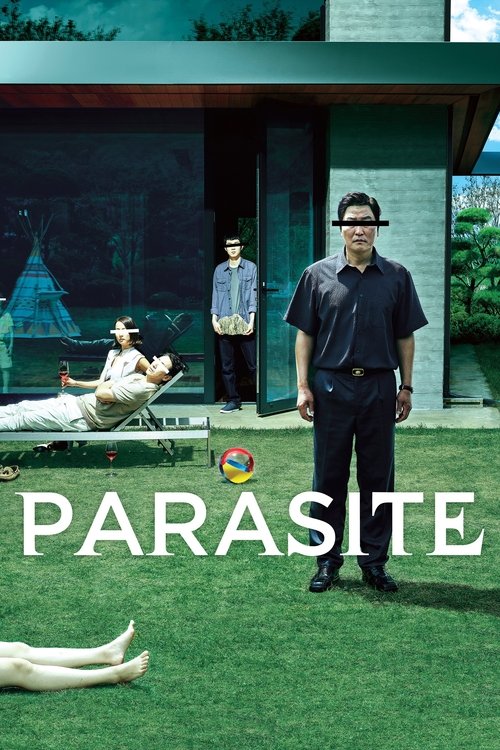
Spoiler Warning
This article contains major spoilers for Parasite (2019).
So what actually happens at the end?
Parasite (2019) ends with the Park family's birthday garden party turned into a slaughter. Geun-sae — the former housekeeper Moon-gwang's husband, who has been hiding in a secret bunker under the Park house for years — climbs out of the basement after the Kims accidentally expose him, stabs Ki-jung in front of the guests, and is in turn killed by Chung-sook. In the chaos, Mr. Park flinches in disgust at Geun-sae's 'basement smell' as he reaches under the bloody body for the car keys; Ki-taek, who has spent the film absorbing every micro-recoil from his employer, picks up the knife and stabs Mr. Park to death, then disappears. The film cuts to a hospital-room epilogue: Ki-jung is dead, Chung-sook and Ki-woo are convicted of fraud and put on probation, and Ki-taek is missing. Watching the Park house from a hill one night, Ki-woo notices the lights of the new owners' motion-sensor lamps flickering in a pattern — Morse code — and realises his father has crawled into the same bunker Geun-sae once occupied. Ki-taek is alive, but he has only inherited the basement. The film closes on Ki-woo's voiceover plan: he will study, earn money, and one day buy the Park house so his father can simply walk up the stairs and out the front door. Bong Joon-ho then cuts back to Ki-woo sitting in the same semi-basement apartment the family started in, signalling that the plan is fantasy. The ending is not a twist but an inheritance: the family has switched basements, and the staircase between them remains uncrossable.
Plot recap leading into the ending
Parasite (Korean: 기생충) is a 2019 South Korean black comedy thriller film directed by Bong Joon Ho, who co-wrote the screenplay with Han Jin-won. It stars Song Kang-ho, Lee Sun-kyun, Cho Yeo-jeong, Choi Woo-shik, Park So-dam, Jang Hye-jin, Park Myung-hoon, and Lee Jung-eun. The film follows a poor family who infiltrate the home and life of a wealthy family.
Timeline of the reveal
The flood
The Parks cut their camping trip short and the Kims, who have been drinking Mr. Park's whisky and luxuriating in his living room, scramble to clean up. Ki-taek, Ki-woo and Ki-jung escape back to their semi-basement to find the neighbourhood drowning in sewage. They sleep on a gymnasium floor with hundreds of other displaced families while the Parks plan an impromptu birthday garden party for their son Da-song.
The basement reveal lands
Earlier, the Kims have already discovered that Moon-gwang, the housekeeper they ousted, has been secretly feeding her husband Geun-sae in a hidden bunker under the Park house for over four years. Moon-gwang dies of a head injury after a struggle on the basement stairs. Geun-sae, now starving and unhinged, waits below ground for his chance to surface and avenge her.
The garden party
Yeon-kyo dresses Ki-taek as an 'Indian' to stage a surprise tomahawk routine for Da-song's party. Geun-sae emerges from the basement with a kitchen knife, kills Ki-jung in front of the assembled guests, and is killed in turn by Chung-sook with a barbecue skewer. Da-song collapses in a seizure at the sight of Geun-sae, whom he recognises as the 'ghost' he saw years earlier.
Ki-taek kills Mr. Park
Mr. Park demands Ki-taek throw him the car keys so he can rush Da-song to a hospital. As he pulls the keys from under Geun-sae's body, Park visibly recoils from the smell. Ki-taek — humiliated all afternoon, his daughter bleeding out beside him — picks up the dropped knife and stabs Mr. Park in the chest. He drops the weapon and walks away from the carnage into the streets of Seoul.
Hospital and Morse code
Months later: Ki-jung is dead, Chung-sook and Ki-woo are convicted of fraud, and Ki-taek has not been found. Recovering from a fractured skull, Ki-woo climbs the hill above the Park house and watches the new German owners' motion-sensor lamps flicker in a coded rhythm. Decoded, the lights spell out a letter from his father, who is hiding in the same bunker Geun-sae once occupied.
The fantasy of buying the house
Ki-woo composes a return letter in voiceover, laying out the plan: he will study, become wealthy, and buy the Park house outright so his father can walk out the front door in daylight. The film visualises the reunion — Ki-taek climbing the stone steps into the courtyard, father and son embracing in the garden — before cutting back to Ki-woo at the small window of the same semi-basement the family lived in at the start.
Character motivations
Ki-taek spends the film absorbing humiliations: the failed cake business, the sewage flooding his home, the gymnasium floor, Mr. Park holding his nose at the steering wheel. The garden-party murder is not a calculated decision but the moment a class wound finally erupts. Watching Park flinch at Geun-sae's smell — the same smell Park has implied clings to Ki-taek himself — clarifies that no service relationship will ever close the gap. He picks up the knife because Park's disgust, more than the chaos, is unanswerable.
Ki-woo begins the film hungry for upward mobility — he forges a university document, calls the Parks' tutoring gig his first chance, and clings to the scholar's stone as a talisman of luck. After the head injury, he can finally see the staircase clearly: the family is trapped below it. His decoded Morse letter and fantasy of buying the house are not delusional optimism but a wounded son's refusal to let his father stay buried. The closing shot in the semi-basement quietly admits the plan has nowhere to go.
Geun-sae has lived in the bunker under the Park house for more than four years, dependent on Moon-gwang for food and bowing in gratitude every time Mr. Park's motion-sensor lights blink on overhead. He worships Park as a benefactor he has never met. When Moon-gwang dies and the Kims trap him below ground, his bond with the surface world snaps. He emerges armed not against the Parks, who he still reveres, but against the Kims, who he experiences as usurpers of the only patron he has.
Mr. Park's motivation across the final act is consistency: protect his son, keep his household functioning, treat the help as appliances. He has already told his wife that Ki-taek's smell 'crosses the line' — the line between staff and family. At the party, his only thought is to get Da-song to a hospital; reaching for the keys under a bloody stranger triggers the same reflex of revulsion he has shown all film. He never registers that the smell is the reason Ki-taek will kill him.
Yeon-kyo is the film's engine of plausible employment. Gullible, anxious, and proud of her sensitive son, she hires the Kims one by one on personal recommendation and stages the disastrous birthday party because Da-song was traumatised by Geun-sae years earlier. Her motivation at the climax is theatrical — she costumes Ki-taek as a tomahawk-wielding warrior to surprise her son — and she has no awareness that the staff she has assembled in her garden are about to dismantle her household within ninety seconds.
The final scene
The closing movement of Parasite is a controlled fantasy and a cut. After the hospital scenes, Ki-woo climbs the hill above the Park house at night and watches the new owners' motion-sensor lamps blink in a pattern. He decodes the Morse: a letter from his father, who is alive in the bunker below the new family's feet, who tells him to look up. Ki-woo sits down to compose a return letter, and Bong Joon-ho lets the voiceover dissolve into image. We see Ki-woo, older, signing the deed to the Park house. We see him walking through the wood-and-glass front door of the building Mr. Park once owned, opening the basement door, and waiting at the top of the stone steps. Ki-taek climbs out into the courtyard, blinking in the sunlight. Father and son meet on the lawn, in the same garden where Ki-jung died, and embrace under a tree without a word. Then Bong cuts. Ki-woo is back at the small half-window of the semi-basement, in the same room he and his family lived in at the start of the film. The voiceover continues in the conditional — 'until that day, please take care, father' — and the camera holds on the unchanged apartment: the toilet still raised above the floor, the street-level window still showing pedestrians' shoes. The fantasy has been a fantasy. Ki-woo is not the new owner of the Park house; he is a convicted fraudster on probation in the same below-ground room he started in, and his father is still in the bunker on the other side of the city. The cut is the film's real ending. The basement-to-house staircase Ki-woo imagined climbing is not a metaphor he can negotiate with effort; it is the architecture of a system. The closing image is not Ki-taek walking up — it is Ki-woo, alone, at the window. Bong frames the fantasy and its collapse in the same minute so the audience cannot leave the theatre believing the family will, in fact, make it. The Morse code letter remains the most affecting object in the ending precisely because it can travel up the hill but a body cannot.
Symbolism
Drawing on Anne Thompson's IndieWire feature with Bong Joon-ho on the staircase blocking, Bong Joon-ho's Cannes 2019 press interview, Variety, Brian Tallerico's RogerEbert.com review, and David Sims's Atlantic review of Parasite.
The symbolism of Parasite (2019) is organised around five tightly-linked objects and spaces: the scholar's stone, the staircase, the smell, the Morse code, and the basement itself. Each one performs a double duty — a private object inside a single shot, and a public argument about how class actually moves in modern South Korea. Bong Joon-ho has been clear in interviews that the film is built from 'images about staircases' and from a smell that he wanted to be palpable enough to cross from the screen into the audience's nose; the symbols are not decoration on a thriller, they are the load-bearing beams.
The scholar's stone
Min gives the Kims the suseok — a traditional Korean viewing stone — early in the film and tells them it is supposed to bring material luck. Ki-woo carries it like a talisman. The most-cited stone shot in the film comes during the flood: as sewage backs up into the semi-basement and the Kims wade through filth to rescue what they can, Ki-woo lifts the heavy stone out of the water and it floats — a small, unsettling impossibility that Bong stages because the audience needs to see that the symbol of upward mobility has no real weight.1 The stone returns as a weapon in the basement, where Ki-woo tries to bludgeon Geun-sae with it and is struck back, sustaining the head injury that frames the hospital epilogue. He has tried to use the dream of wealth as a tool of class violence; the dream knocks him out. The film closes on him returning the stone to a river. The scholar's stone, then, is the film's most compact emblem of the false promise — beautiful, traditional, marketed as luck, and ultimately something Ki-woo has to put back down before he can write the Morse-letter scene at all.4
The staircase
Parasite is, in Bong's own description, a stairway film.1 The Kims live below street level; the gymnasium where they sleep after the flood is reached by going down again; the Park house is reached by climbing a stone staircase from the road, and inside the house another staircase descends to a hidden bunker. Bong choreographs the famous 'descent' sequence — the Kims fleeing the Park living room during the storm, running downhill through Seoul in the rain, every cut a step further down — so the audience physically feels the verticality of class.3 The visual rule is consistent: wealth is reached by going up, and any temporary movement upward (the Kims getting their service jobs, drinking Park's whisky) is immediately followed by a longer descent. The bunker doubles down on the joke: even at the bottom, there is another bottom. The staircase is not a metaphor the film hides; it is the film's blocking.
The smell
Bong has called the smell motif the film's 'most important sensory element.'2 Mr. Park complains about it twice — once in the car, once in the privacy of his own bedroom, where he tells Yeon-kyo that Ki-taek has a particular odour that 'crosses the line.' Da-song notices it on the very first day, sniffing all four Kims and announcing that they smell the same — the detail that nearly exposes the conspiracy. The smell is the only sensory marker in the film that money cannot fully scrub away: the Kims can buy new clothes and forge new credentials, but the subway-and-semi-basement scent stays. Bong's decision to make the smell, rather than wealth or appearance, the irreducible class marker is precise — it cannot be photographed, but the audience hears the Parks discuss it often enough that by the garden party, when Mr. Park flinches at Geun-sae's body, the entire theatre understands what Ki-taek is being told about himself.
The Morse code
When Ki-woo decodes the motion-sensor lamps from the hill above the Park house, the film is making a quiet formal argument about what kind of communication is possible across the staircase. Ki-taek cannot leave the bunker without being arrested. He cannot phone, cannot write, cannot be seen. He can, however, send a one-bit signal — on/off — by pressing the same light switch Geun-sae used to bow to Mr. Park. The Morse channel is the only form of contact the architecture permits, and it goes only in one direction: down to up. Bong is sharpening the same point the stone made — the symbols of connection survive, but bodies cannot follow them.
The basement
The bunker under the Park house is the film's most loaded space, partly because it is so specifically South Korean. Architect Namgoong, the previous owner, built it as a fallout shelter against the threat of North Korean invasion — a detail the housekeeper Moon-gwang mentions almost in passing. The basement is the country's anxious infrastructure, made literal: a hidden compartment of the wealthy home where someone has been living for years without the owners noticing. By the end, the basement has changed occupant — Ki-taek has replaced Geun-sae — but the room itself is unchanged. The symbol's final point is that the basement is not a person, it is a position; the only thing that changes is the family forced to occupy it.
Themes
Drawing on Bong Joon-ho's Cannes 2019 press interview, Variety, Brian Tallerico's RogerEbert.com review, and David Sims's Atlantic review of Parasite.
Parasite (2019) holds four braided themes: vertical class hierarchy, the parasite-versus-host inversion at the centre of the title, the illusion that any 'plan' can navigate a stratified system, and the invisible infrastructure of domestic service that capitalism quietly relies on. Bong Joon-ho has been explicit that the film is not a metaphor for South Korea alone — at the 2019 Cannes press conference he framed it as a portrait of late capitalism more broadly2 — and the themes work in any city where domestic labour, real estate, and credentialism intersect.
Vertical class hierarchy
The film is staged so that class is a physical altitude, not a state of mind. The Kims live below the street; the Parks live above it; the bunker lives below the basement. Every meaningful movement of money or service in the film is also a movement up or down a staircase. Bong refuses to flatter the audience with a moment in which the Kims and the Parks meet on the same plane: the Kims are admitted to the Park living room only as workers, and only the children are ever allowed to sit in the garden. When the staircase reverses — the Kims fleeing the Parks' house, descending into the flood — the camera follows the water, and the descent does not stop until they are sleeping on a gymnasium floor below their own apartment. The film's thesis on hierarchy is that the staircase exists, that it is not a metaphor, and that the smell which clings to Ki-taek is the marker of which side of the railing his body comes from.
Parasite versus host
The title is a deliberate provocation: which family is the parasite?3 The Kims insert themselves into the Park household one by one, displacing the existing chauffeur and housekeeper through fabrication; they drink the Parks' whisky, sleep on their sofa, and live, briefly, off their salary. That reading is the obvious one. The film keeps swapping the relationship, though. The Parks, in turn, depend on the Kims to drive, cook, tutor, and emotionally manage their son — they cannot operate their own household without four invisible workers, plus, unbeknownst to them, a fifth tenant in the basement. Geun-sae, the film's purest case, has lived under the Parks' floorboards for over four years on food smuggled by his wife. He bows to Mr. Park's motion-sensor lights and calls him patron. Bong's point is not to settle the question of which family is the parasite but to dissolve it: in this house, every relationship is parasitic and every relationship is symbiotic, and the staircase is what determines which word you get to use.4
The illusion of plan
Ki-taek says it twice — once in a flooded gymnasium, once in the car ride back to the Parks' garden party — that the best plan is no plan, because plans never survive contact with reality. The line is the film's clearest piece of working-class philosophy, and it sits in direct opposition to the credentialed plans of the upper-middle class. Yeon-kyo plans menus, parties, art-therapy regimens, university trajectories for Da-song; Ki-woo forges a Yonsei University document because the planning Yeon-kyo respects is the only currency she will read. By the time the garden party collapses into multiple murders within ninety seconds, every plan in the film has failed. Bong is not arguing that planning is bad; he is arguing that in a stratified system, the people without leverage cannot plan, because their plans are budgets the world will not honour. The film's tragedy is that Ki-woo does not learn this. In the epilogue he is still writing a plan: study, work, buy the house. The film cuts away from his plan to the same semi-basement, in the same shot construction Bong used at the start. Ki-woo has inherited his father's line about plans without yet hearing it.
Capitalism's invisible infrastructure
The deepest theme of Parasite is the labour the Parks do not see. Yeon-kyo confesses she could not run her household without the chauffeur and the housekeeper; she cannot drive in Seoul traffic, cannot cook the dishes she serves, cannot supervise her own son's tutoring. The household is a small economy that requires four full-time workers and one secret tenant to function — none of whom the family really knows. The bunker is the most extreme version of this invisibility: a man has been living below their feet for years, bowing to the lights they turn on, and they have never noticed because they have never had reason to look. Bong's argument is that the wealthy household runs on infrastructure that is, by design, invisible to its owners; the moment any of that infrastructure becomes visible — the smell, the body, the basement — the household responds with revulsion rather than recognition. The film's violence happens because Mr. Park, asked by reality to see his own infrastructure, still refuses to.
Final shot interpretation
Drawing on Anne Thompson's IndieWire feature with Bong Joon-ho on the staircase blocking, Bong Joon-ho's Cannes 2019 press interview, Variety, Brian Tallerico's RogerEbert.com review, and David Sims's Atlantic review of Parasite.
The final shot of Parasite (2019) is two shots, set against each other inside the same minute: a fantasy of Ki-taek walking out the front door of the Park house and a hard cut back to Ki-woo at the half-window of the same semi-basement the family started in. The cut is the film's argument — and Bong Joon-ho has confirmed in multiple interviews that the bleakness is deliberate, that he wanted the audience to leave the theatre with no ambiguity about whether the Kims escape.12
The fantasy of buying the house
Bong stages the imagined ending with all the warmth the rest of the film withholds. Ki-woo, older, walks through the wooden front door of the Park house in daylight. He signs a deed. He waits in the courtyard. Ki-taek emerges from the basement, blinking, climbs the stone steps, and meets his son on the lawn. The camera lingers in the garden — the same garden where Ki-jung died — and Bong allows a beat of physical reunion the rest of the film has not earned. The lighting is warmer, the music is gentler, and for thirty seconds the film looks like the kind of catharsis Hollywood would deliver. The audience is being shown what closure would feel like if the staircase could be climbed.
The cut to the semi-basement
Then Bong cuts. Ki-woo is at the half-window of the family's old apartment — the same window the film opened on in the first shot, with pedestrians' feet visible above his head. The voiceover continues in the conditional, in subjunctive Korean grammar that English subtitles translate as 'until that day, please take care, father.' The room has not changed. The toilet still sits raised above the floor. The street-level window still shows the same shoes. Ki-woo has not become wealthy. The Park house has not been bought. The reunion has not happened. The cut is the entire ending: the film's last thirty seconds of fantasy are stripped of their authority by being placed next to the unchanged room.
Capitalism's promise as fantasy
The structure of the final shot is the film's clearest indictment.3 Bong has built two and a quarter hours of staircase imagery, smell motifs, scholar's-stone shots, and bunker reveals, and he closes the argument by showing that even the protagonist who has lived through all of it cannot give up the fantasy of buying himself out. Ki-woo writes the letter not because he believes the plan is plausible — the film has told us how much Seoul real estate costs, and how few decades of fraud salary it would take to assemble — but because the only way to keep his father alive in his head is to imagine the staircase as something a person can climb with effort. Bong's final shot is the bleakest possible read of capitalism's mobility promise: not that the promise is false, but that the people inside the system cannot afford to stop believing it even when they have seen, with their own eyes, that it is.
The unbroken inheritance of the basement
The other quiet point of the final shot is that the basement has not closed. The new German owners of the Park house do not know about the bunker. Ki-taek is in it. If he is found, he will be arrested; if he stays, he will eventually die there. The motion-sensor lights still blink whenever he moves below them. The structural problem the film has identified — a hidden compartment of every wealthy home, occupied by someone the owners have never met — has simply changed occupant. Moon-gwang and Geun-sae are dead; Ki-taek has replaced them. The next housekeeper, the next chauffeur, the next tenant of the semi-basement will face the same staircase. The closing image of Ki-woo at the half-window is, finally, the same image the film opened on, with one new piece of information: now we know who is underneath. Bong's final shot is not a coda. It is the same room, in a circle, with the basement still occupied.4
Back to the full movie guide
Plot, cast, where to watch, and similar films — without spoilers.
Open guide →Frequently Asked
Why does Ki-taek kill Mr. Park?
The murder is the cumulative result of a class-coded smell motif that Bong threads through the entire film. Mr. Park has already told Yeon-kyo that Ki-taek's odour 'crosses the line' — the subway smell of people who live in semi-basements. At the garden party, Park reaches under Geun-sae's bleeding body for the car keys and visibly recoils, pinching his nose, in the same gesture Ki-taek has watched him perform for weeks. Ki-taek's daughter has just been stabbed in front of him; Park is still treating staff as olfactory inconveniences. The stabbing is the moment Ki-taek refuses to be the smell he has carried into the house.
Is Ki-woo's plan to buy the house real or imagined?
Imagined. Bong stages the reunion in the Park garden as if it has happened — Ki-woo signing papers, Ki-taek climbing out of the bunker, father and son embracing on the lawn — then cuts back to Ki-woo sitting at the half-window of the same semi-basement the Kims have lived in all film. The voiceover stays in the conditional ('until that day'), and Ki-woo never leaves the room. The plan is meant to read as a wounded son's refusal to give up rather than as foreshadowed possibility. South Korean real-estate prices alone — the running joke the film makes when Ki-woo calculates how long it would take to earn that much money — quietly close the door.
What does the scholar's stone symbolise?
The viewing stone (a suseok) is gifted to the Kims by Ki-woo's rich friend Min as a talisman that supposedly attracts material wealth. Ki-woo carries it everywhere, including into the flooded semi-basement, where it floats — a detail Bong stages so the audience registers that the symbol of upward mobility is hollow. In the basement confrontation with Geun-sae, Ki-woo uses the stone as a weapon and is struck with it himself, fracturing his skull. The stone delivers the wound that finally lets him see the staircase clearly. In the hospital epilogue, Ki-woo returns it to a riverbank — the only object in the film he chooses to put back where it came from.
Why is Geun-sae living in the basement?
Geun-sae owed money to loan sharks after his Taiwanese castella-cake franchise failed — the same business Ki-taek tried and failed at, a quiet rhyme Bong plants in the dialogue. Moon-gwang, his wife, took the live-in housekeeper job under the previous owner of the Park house (the architect Namgoong) and smuggled Geun-sae into the hidden fallout-shelter bunker the architect had built. The Parks bought the house without learning about the bunker. Geun-sae has lived underground for over four years, eating leftovers Moon-gwang sneaks down to him, and reveres Mr. Park as the absent patron who keeps the lights on overhead.
Does Ki-taek ever see his son again?
No — at least not within the film. The reunion at the Park house is explicitly the fantasy half of the final sequence; Bong cuts away from it back to the semi-basement to mark it as wish, not event. The only contact the father and son have at the end of the film is the one-way channel of the motion-sensor lamps: Ki-taek can blink Morse from the basement, but he cannot leave, and Ki-woo can read the message but cannot answer. The ending denies the family a meeting on purpose, because Bong is staging inheritance, not catharsis.