Spoiler Warning
This article contains major spoilers for Aftersun (2022).
So what actually happens at the end?
Aftersun (2022) ends with the MiniDV camcorder turning from young Sophie at the Turkish-resort airport gate to her father Calum walking through two distant doors into a strobe-lit rave. The shot collapses Charlotte Wells's three time-layers — the 1999 holiday, the adult-Sophie present in which she is watching the tapes, and the imagined rave-room where she keeps trying to find Calum — into a single image. The film refuses to confirm Calum's fate.
Plot recap leading into the ending
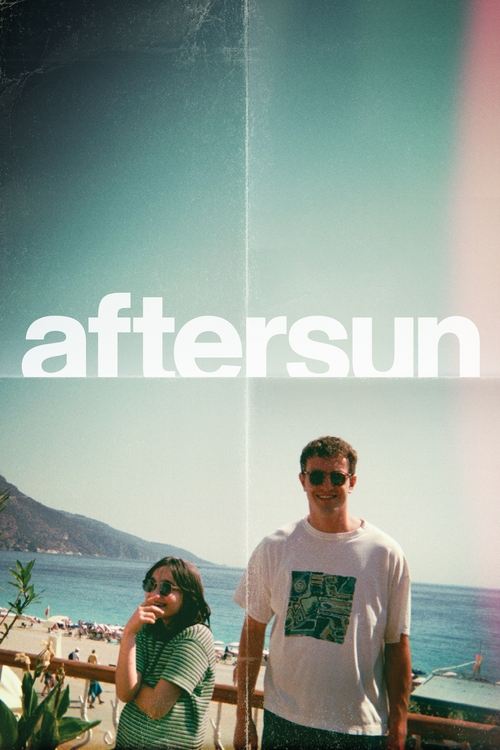
Aftersun is a 2022 semi-autobiographical coming-of-age drama film written and directed by Charlotte Wells in her feature directorial debut. Starring Paul Mescal, Frankie Corio, and Celia Rowlson-Hall, the film is loosely based on Wells' childhood and follows an 11-year-old Scottish girl on holiday with her father at a Turkish resort on the eve of his 31st birthday.
Symbolism
Drawing on Sam Adams's Slate essay on the final shot, Ella Kemp's NME ending explainer, Charlotte Wells's BFI Sight & Sound interview with Adam Nayman, and Charlotte Wells's IndieWire interview with Eric Kohn.
The symbolism of Aftersun (2022) is organised by three media: the MiniDV camcorder that records what young Sophie saw at the Turkish resort, the Polaroid camera that holds a single moment of past light, and the strobe-lit rave room that stages adult Sophie's failed search for her father. Aftersun is a film about a holiday but it is structured by three formal devices, each one functioning at the level of symbol as much as image: the MiniDV camcorder Sophie carries through the resort, the Polaroid camera that surfaces in a single scene, and the strobe-lit rave room where adult Sophie keeps trying to find her father. The film's argument lives in the seams between these three media.
The MiniDV camcorder
Charlotte Wells has been explicit that the camcorder is not décor; it is the film's organising lens. In Adam Nayman's BFI Sight & Sound interview, she described how the device entered the script late but immediately became load-bearing: "The camera makes it into a game. [The camera] wasn't always in the script, but I like that it offered a literal point of view."4 What the camcorder produces inside the film is a second layer of footage Sophie thinks is hers — a holiday diary — and that adult Sophie, twenty years later, has been re-watching as evidence. Cinematographer Gregory Oke's broader framing reinforces the split, Wells told Nayman: Calum's "unravelling, while private and concealed to Sophie, is visible to an audience."4 The DV footage is the symbol of what the child saw; the wider 35mm camera is the symbol of what only an adult, watching back, can see.
The Polaroid
Inside that two-layer scheme the film also slips in a third, slower medium. In the same BFI conversation, Wells noted the formal pleasure of Polaroid time: "I like the shots where we could be looking at something then, or now, or a thousand years ago."4 The Polaroid scene compresses the film's temporal claim into one shot — a chemical surface that develops before the audience's eyes but contains a moment that was already past. Where the MiniDV stores motion, the Polaroid stores light; together they perform the difference between memory as continuous tape (which Sophie has) and memory as held still image (which is what grief works in).
The rave room
The third symbol is spatial. Across the film, brief strobe-lit interludes show adult Sophie searching a crowded dance floor for someone she can never quite reach. Sam Adams, writing for Slate on what he calls one of the best final shots in years, names that space as "the imagined liminal space where Sophie and her father can finally meet."2 Ella Kemp in NME reads the same room as not a literal reunion but "an emotional convergence" — a stylised idiom for the disorientation of grief, with strobe and black frames doing the work plain prose can't.3 Eric Kohn's IndieWire interview pins down what Wells was after at the level of bodily sensation: "I came increasingly interested in the physiological response it caused."5 The rave is the closest Aftersun comes to a metaphysical room. It is not in 1999 and it is not now; it is the room where adult Sophie keeps trying to put the question to her father, with the strobe acting as the visual equivalent of incomplete recovery — flashes of him, never the whole man.
Together the three devices function as a single argument about what kind of object Aftersun is. The camcorder gives the audience the child's footage; the Polaroid gives them the still image that was always already past; the rave gives them the adult viewer's irreducible need to keep returning. Each one tells the audience how to listen to the next.
Themes
Drawing on Charlotte Wells's Hollywood Reporter interview with Seija Rankin, Ella Kemp's NME ending explainer, Charlotte Wells's BFI Sight & Sound interview with Adam Nayman, and Charlotte Wells's IndieWire interview with Eric Kohn.
The themes of Aftersun (2022) are three: withholding as a moral and formal ethic that refuses to name Calum's condition, the gap between what an eleven-year-old daughter saw and what an adult viewer can see watching the tapes back, and grief as the film's organising principle rather than its plot beat. Three themes hold Aftersun together: a defence of withholding as a moral as well as a formal stance, the difference between what a daughter saw and what an adult viewer can see, and grief as the film's actual organising principle rather than as its plot.
Withholding as the film's ethic
Charlotte Wells has been unusually explicit about the film's refusal to name Calum's condition. Speaking to Seija Rankin at the Hollywood Reporter, she framed the choice as a generosity rather than a withholding: "I will never deny somebody's experience of the film. I think the loss at the end resonates just as deeply for everyone, regardless of how you're filling in the gaps in the story."1 In Eric Kohn's IndieWire interview, she expanded on the discipline this required: "For me, this is this interesting balance between subtlety and withholding information."5 Critics have read the choice in the same key. Ella Kemp's NME piece argues that Aftersun is "a much better film for its tenderness" precisely because Wells "avoids imposing any one conclusion about Calum's mental health or Sophie's grief."3 What is unusual about Aftersun, in other words, is not that it does not say what is wrong with Calum, but that it treats not-saying as a position with content. The film honours both readings of him — depressed-and-trying, suicidal-and-trying — and asks the audience to live in the same uncertainty Sophie has lived in.
The two-layered seeing
The film's narrative engine is the gap between what young Sophie observed at eleven and what adult Sophie, watching the tapes, recognises now. Wells told Adam Nayman at BFI Sight & Sound that her cinematographer Gregory Oke's framing was built around exactly that gap — what Calum keeps off-frame from Sophie, the camera carefully puts inside the audience's frame.4 The audience occupies a structural position the child cannot: catching the late-night swim, the mirror spit, the suppressed sob in the airport hallway. Wells's point is not that adult Sophie is now smarter than young Sophie; it is that what an adult sees when they go back to the footage is, in part, the price of growing up. Rankin's interview surfaces the corollary, in Wells's own voice: their relationship is "intimate and loving," not estranged.1 The film's two-layered seeing is therefore not a betrayal of the holiday memory; it is a deepening of it.
Grief as the organising principle
When Nayman asked Wells what the film is about, she gave the answer the film's title already implies: "There's room for slightly different takes on the ending... For me, it's about grief, and some paths to that are more obvious than others."4 Grief, in Aftersun, is not a plot beat that arrives in the final five minutes; it is the formal pressure that has been shaping every choice from the cold open onward — the camcorder cut-ins, the rave's strobe disorientation, the long held shots of Calum alone on the balcony. Eric Kohn's interview catches the working-method behind that pressure: "I was willing to fail trying rather than trying to pursue a safer version of this film."5 The safer film, presumably, would have told the audience what happened to Calum after the holiday and let them grieve on cue. Aftersun's argument is that real grief does not work on cue, and that the film's job is to build a room — an aftersun room — where its audience can sit inside the same not-knowing the daughter has lived in for two decades.
Final shot interpretation
Drawing on Charlotte Wells's Hollywood Reporter interview with Seija Rankin, Sam Adams's Slate essay on the final shot, Ella Kemp's NME ending explainer, and Charlotte Wells's BFI Sight & Sound interview with Adam Nayman.
The final shot of Aftersun (2022) is a single engineered move at the Turkish-resort airport gate: the MiniDV camera turns from young Sophie boarding her flight to Calum walking through two distant doors into the strobe-lit rave room — one composition that collapses the film's three time-layers (the 1999 holiday, the adult-Sophie present in which she is rewatching the tapes, and the imagined liminal space where she keeps searching for him) into a single image and refuses to confirm Calum's fate. The closing minutes of Aftersun execute a single, tightly-engineered move — a camera spin, a door swing, a strobe — that resolves the film's structure without spoken explanation. The sequence is built so cleanly that critics writing about it weeks after release converged on the same structural read: this is the place where Wells folds the film's three time-layers into one image.
The airport-camera spin
After the last beach day, the holiday ends with Sophie boarding her flight back to her mother. Calum holds the MiniDV camcorder up and waves. The camera then performs the film's most decisive trick: it turns away from Sophie and keeps turning until it lands on Calum standing in an airport hallway, holding the same camcorder. Sam Adams's Slate essay walks the move beat by beat: the device "keeps turning" until it finds Calum, who places the camcorder in his backpack and walks toward "what lies beyond" two distant doors — "blackness, and the flash of strobe lights."2 The reveal underneath the spin is that the footage we have been watching is not 1999 in real time; it is adult Sophie's archive, being watched in the present.
The doors swing into the rave
What the doors open into is the strobe-lit room the film has been cutting to all along. Adams names what the room does in the film's architecture: "In one shot, Wells ties together the film's three worlds: the present, the past, and the imagined liminal space where Sophie and her father can finally meet."2 The rave's grammar — strobe, black frames, partial visibility — has been the film's recurring cut-in for ninety minutes; what happens at the end is that the cut-in finally has an entrance. The airport corridor doors give the adult-Sophie subliminal space a physical threshold inside the past-tense holiday footage, and the structural argument the film has been quietly making about grief's geometry is suddenly literalised on screen.
What the final shot refuses to confirm
The film stops short of telling the audience what happens to Calum after the airport. Kemp captures the deliberate withholding plainly: "It's not clear where Calum goes, or whether Sophie sees him again after the holiday shown in Aftersun."3 Wells has been consistent across her major interviews about why the film refuses to clarify. She has said in both her Hollywood Reporter conversation with Seija Rankin1 and her BFI Sight & Sound interview with Adam Nayman4 that the loss the ending registers reads at full strength regardless of which interpretation a viewer settles on, and that the actual subject the ambiguity is in service of is grief itself rather than a diagnostic answer about Calum. The final shot does not let the audience off the hook of that ambiguity; it converts the ambiguity into a stable image.
Why the move works
The triple-layered ending lands because Wells has spent the previous ninety minutes earning every part of it. The camcorder has been Sophie's child-diary throughout; the rave has been the adult-Sophie subliminal cut-in throughout; the present-day apartment with the tapes has been quietly held in reserve. When all three meet in the final shot, the film has not introduced a new device — it has revealed what the device has been all along. The audience leaves the cinema with what Wells has called her actual subject in plain terms4: a grief-shaped room, with the daughter still in it, and the door still slightly ajar onto the room where her father is dancing.
Back to the full movie guide
Plot, cast, where to watch, and similar films — without spoilers.
Open guide →Frequently Asked
What is Aftersun about?
Sophie reflects on the shared joy and private melancholy of a holiday she took with her father twenty years earlier.
Where can I watch Aftersun?
See the Where to Watch section below for the current streaming, rental, and purchase options in your region.