Spoiler Warning
This article contains major spoilers for Oppenheimer (2023).
So what actually happens at the end?
Oppenheimer (2023) ends with two overlapping verdicts: a public one against Lewis Strauss in his 1959 Senate confirmation vote, and a private one Oppenheimer pronounces against himself in a remembered conversation with Albert Einstein at the Institute for Advanced Study pond. The film cross-cuts Strauss's defeat — engineered behind the scenes by David Hill's Senate testimony about the rigged 1954 security hearing — with a flashback that reveals what Oppenheimer and Einstein actually said to each other in the scene Strauss spent the whole film misreading from across the lawn. In the flashback, Oppenheimer hands Einstein the Bethe calculations from before Trinity — the ones that had briefly suggested the atmosphere might catch fire when the device was detonated. He tells Einstein the math came back acceptable but not zero. Einstein returns the papers and walks past Strauss without acknowledging him. Then Nolan replays the pond from Oppenheimer's side, and we hear the rest of what Oppenheimer says: "I believe we did." He is answering Einstein's earlier question about whether the chain reaction has begun — not the literal atmospheric one Bethe ruled out, but the moral and political chain reaction of nuclear weapons in the human world. As Oppenheimer says it, Nolan cuts to silos opening, missiles arcing, and a vision of the planet's surface lit by fire — Oppenheimer's foresight of the world the bomb was already making while the Trinity device was still on its tower. The film closes on this image, not on a rescue, not on a verdict, not on the hearing room: just rainwater rippling outward, a man who knows what he has done, and a chain reaction that the rest of the twentieth century — and the twenty-first — will have to live inside.
Plot recap leading into the ending
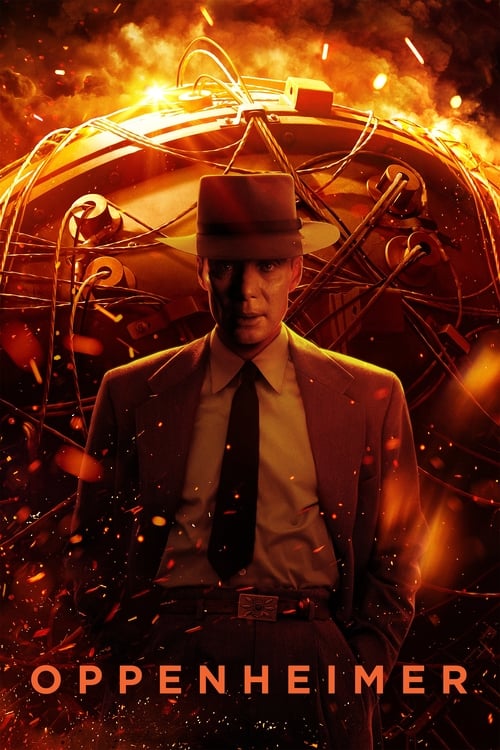
Oppenheimer is a 2023 epic biographical thriller film written, co-produced, and directed by Christopher Nolan. It follows the life of J. Robert Oppenheimer, the British theoretical physicist who helped develop the first nuclear weapons during World War II. Based on the 2005 biography American Prometheus by Kai Bird and Martin J. Sherwin, the film dramatizes Oppenheimer's studies, his direction of the Los Alamos Laboratory and his 1954 security hearing. Cillian Murphy stars as Oppenheimer, alongside Robert Downey Jr. as the United States Atomic Energy Commission member Lewis Strauss. The ensemble supporting cast includes Emily Blunt, Matt Damon, Florence Pugh, Josh Hartnett, Casey Affleck, Rami Malek, and Kenneth Branagh.
Timeline of the reveal
The Trinity test
At Alamogordo, the gadget detonates. Nolan holds on the soundless flash for a long, suspended beat before the shockwave reaches the bunker. Oppenheimer reads, internally, the line from the Bhagavad Gita he later spoke aloud. Kistiakowsky collects on his bet; Bainbridge tells Oppenheimer he is now a son of a bitch.
The Hiroshima briefing and the cheer
After Hiroshima, Oppenheimer addresses the Los Alamos auditorium to thunderous, foot-stamping applause. Nolan stages it as a hallucinatory inversion of the Trinity countdown: a woman's face peels away, a man in the front row weeps, the cheering becomes static. Oppenheimer thanks the lab, then walks out past a charred body he has imagined onto the gymnasium floor.
The Strauss-Oppenheimer-Einstein misread
In black-and-white, Strauss watches Oppenheimer speak to Einstein at the Institute pond. Einstein walks past Strauss without greeting him. Strauss decides, in the moment we now realise, that whatever Oppenheimer said about him at that pond is the wound that will organise the rest of his public life. The film files the scene away to be reopened in the final minutes.
The kangaroo-court confrontation
In Room 2022 of the AEC's temporary buildings, Roger Robb cross-examines Oppenheimer about Jean Tatlock, the Chevalier incident, and his hydrogen-bomb testimony while Kitty looks on. The hearing strips Oppenheimer of his Q clearance by a 2-1 vote. He has been not so much judged as administratively erased.
Strauss's confirmation collapses
The Fusion thread arrives at its hinge. David Hill testifies before the Senate that Strauss engineered the Oppenheimer hearing out of personal grievance. The confirmation vote fails. Strauss, in his own private corridor, demands of his aide to be told what Oppenheimer and Einstein discussed at the pond. We are about to learn the answer.
The chain reaction has begun
Nolan returns to the pond from Oppenheimer's side. Oppenheimer hands Einstein the pre-Trinity ignition calculations. Einstein returns them. Oppenheimer says, of the chain reaction Einstein once feared, "I believe we did." Cut to silos opening, missiles arcing, the world's surface lit by fire. Rainwater ripples on the pond and the film ends.
Character motivations
By the final act Oppenheimer is no longer trying to win — not the war, not the hearing, not history. He is trying to make himself legible to himself. He stops defending against Robb because the cross-examination is, in a precise sense, his own internal monologue spoken aloud. His refusal to fight Strauss publicly is the same refusal he has been practising since Hiroshima: a man performing penance through deliberate institutional disappearance.
Strauss reads every room as a referendum on himself. His pursuit of Oppenheimer is bureaucratic in its mechanics and personal in its origin: a humiliation at a chalkboard, a snub at a pond, a sense that the country's most celebrated physicist looks down on a self-made shoe-salesman-turned-financier. He weaponises the AEC's procedural machinery to administer a private grievance, and the Senate vote in 1959 is the film's verdict that the country finally saw it.
Einstein, by the time of the pond scene, has already lived the arc Oppenheimer is just entering. He recognises the position of the celebrated scientist betrayed by the state that adopted him, and his warning to Oppenheimer — that they will give him a salmon dinner and a medal and convince him they have forgiven him — is the film's clearest articulation of how the American postwar establishment metabolises men like them. His walking past Strauss is not personal; it is the gesture of a man who has stopped pretending.
Kitty is the only character who refuses to perform contrition. She drinks through Los Alamos, dares Robb to break her on the stand, and pointedly refuses to shake Edward Teller's hand at the postwar ceremony. Where Oppenheimer's penance takes the form of accepting his erasure, Kitty's loyalty takes the form of refusing to grant the apparatus the moral closure it is asking for. She is the film's anti-confessional conscience.
Tatlock is dead before the third act begins, but her presence governs the hearing. Robb uses her to corner Oppenheimer with the question of his March 1943 visit to her apartment, and the cross-examination is staged as Oppenheimer's own remembered guilt rather than a discovered fact. Her motivation, while she lived, was political and personal in inseparable proportion: she loved Oppenheimer, she distrusted his accommodation with power, and she would not let him have either her or the bomb on cleanly resolved terms.
The final scene
The closing image of Oppenheimer is not a face, not a courtroom, not the mushroom cloud. It is rainwater landing on the surface of a small pond at the Institute for Advanced Study, in a flashback to 1947, and the concentric rings expanding outward from each drop. Nolan has been building toward this image for three hours. He has shown us, twice already, the Strauss-side version of this scene: Oppenheimer talking to Einstein, Einstein walking past Strauss without a word. He has shown us the pre-Trinity calculation Oppenheimer carried to Hans Bethe, the one that put the probability of igniting the atmosphere at "near zero" but not at zero. He has shown us Oppenheimer reading Sanskrit, watching a body burn that no one else can see, and standing on the Los Alamos auditorium stage as the floor falls out from under him. All of those threads are knotted at the pond. Oppenheimer hands Einstein the paper. Einstein hands it back and says, in essence: I cannot help you with this, I am no longer the one to whom this is being addressed. Then the conversation Strauss has spent the film trying to interpret resolves with the line Strauss never gets to hear: "When I came to you with those calculations, we thought we might start a chain reaction that would destroy the entire world." Einstein: "I remember it well." Oppenheimer: "What of it?" Oppenheimer: "I believe we did." As he says it, Nolan cuts. Silos open. Missiles climb above a low horizon. The camera pulls back from a curve of the planet whose surface is, in Oppenheimer's mental image, already on fire. Then we are back at the pond, on Oppenheimer's face, and the rain begins. The ripples on the water are doing two pieces of work at once. They are the physical record of falling drops — a perfectly literal chain of expanding wavefronts. And they are Oppenheimer's vision of the moral consequence he had already imagined at Trinity, now arriving as the rest of the twentieth century. The chain reaction is not the bomb. The chain reaction is the world the bomb made, and the film closes on its first measurable ripple, expanding outward at the speed of physics, with no edge in sight.
Symbolism
Drawing on Christopher Nolan to John Mecklin (Bulletin of the Atomic Scientists, July 2023), Hoyte van Hoytema in The Credits (Motion Picture Association, August 2023), and Ludwig Göransson in The Hollywood Reporter (2023).
The symbolism of Oppenheimer (2023) is organised around a small set of repeating images Nolan uses to argue, in pictures, what the film is arguing in dialogue: that subjective experience and historical record run on different rails, that knowledge is a kind of poison once it is given a body, and that the chain reaction the bomb makes is older and slower than the one it detonates.
Black-and-white versus color
Nolan separates the film into two photographic registers and tells the audience how to read them with onscreen text: color sequences are labelled "Fission," black-and-white sequences "Fusion." Fission is Oppenheimer's first-person account — what he saw, what he felt, what he chose to remember. Fusion is the objective register, organised around the 1959 Strauss confirmation hearing, in which other people's testimony reconstructs Oppenheimer's life from the outside. Cinematographer Hoyte van Hoytema described the color register to The Credits in August 2023 as an attempt "to create a feeling of living in Oppenheimer's head…to touch on the way he changed traditional physics into the new abstract world of quantum physics," with the Strauss black-and-white sequences carrying the external, public account by contrast.3 The distinction is more than stylistic. The color sequences contain the film's hallucinations: the burning body on the auditorium floor, the woman's face peeling away in the front row, the chain-reaction vision at the pond. The black-and-white sequences contain almost none. Nolan is making a Cartesian argument about historical knowledge — that interiority is in color and the public record is in monochrome, and that the gap between them is the space inside which a man like Strauss can engineer a hearing and a man like Oppenheimer can absorb it.
The apple
The film's first significant symbolic act is Oppenheimer, homesick and undone at Cambridge, injecting a Granny Smith with potassium cyanide and leaving it on Patrick Blackett's desk. He returns the next morning, intercepts Niels Bohr before Bohr can pick it up, and slices the apple in half with a paperknife. The shot is held long enough for the audience to register the symbol three ways at once: the apple of Eden (forbidden knowledge), the poisoned apple of fairy tale (the gift that kills), and the apple as Newton's image (the falling object that taught physics how to read gravity). The apple returns, structurally, every time Oppenheimer hands over a piece of knowledge that he knows is more lethal than the recipient understands — the calculations to Bethe, the gadget to Groves, the testimony to Robb. Nolan has built the apple into the film's grammar so that when Oppenheimer says, much later, "I believe we did," the audience hears: the apple has been picked, the orchard is on fire.
Rain ripples on the pond
The pond at the Institute for Advanced Study is the film's most-loaded location. We see it three times, in three different registers. The first time, from Strauss's side, in black and white: Oppenheimer leans in to say something, Einstein turns away, Einstein walks past Strauss without a word. The second time, from Strauss's narration, replayed as he becomes obsessed with what was said. The third time, from Oppenheimer's side, in color, in the film's final two minutes. In the third version, after Oppenheimer has finished speaking, rain begins. The drops land on the pond's surface and concentric rings expand. The ripple is the film's master symbol. It is the literal physics of a wavefront — the same wavefront Trinity sent through Alamogordo at the speed of sound. It is the bureaucratic ripple Strauss's grievance is sending through the AEC. It is the historical ripple Oppenheimer's "I believe we did" is meant to identify, expanding outward in time toward the silos that Nolan cuts to next. Nolan told the Bulletin of the Atomic Scientists' John Mecklin in July 2023 that Oppenheimer is "the ultimate Rorschach test," with viewers reading into him "all that is great and all that is terrible about America's uniquely modern power" — the pond's ripples are the visual form of that test, the same set of widening rings asked to carry the physics, the bureaucracy, and the moral consequence at once.1 One image carries three time-scales of consequence and asks the audience to hold them simultaneously.
The Trinity countdown clock
Nolan stages the Trinity test as a sequence of objects that measure time without making it pass: the chalkboard probability table, the radio voice counting backward, the clock face mounted on the bunker wall, the pencil tapping on the desk. The countdown clock is the only object that functions as a near-character. Nolan uses it to set the audience's heartbeat and then withhold the resolution; the flash arrives soundlessly, and the clock keeps ticking even after the light. Composer Ludwig Göransson, speaking to The Hollywood Reporter in 2023, described the violin as the score's interior instrument — "sometimes it's the solo violinist portraying the most intimate thoughts of Oppenheimer" — and the countdown sequence is where that violin and the clock face fuse into a single ticking object.5 The countdown is a symbol about the difference between knowing something will happen and experiencing it happen. Bethe's calculation had told the room what to expect. The clock turned the calculation into an embodied waiting, and the silence after the flash turned the waiting into a permanent condition the rest of the film cannot leave.
Ash on Oppenheimer's shoes
After Hiroshima, in the corridor outside the auditorium, Oppenheimer walks past what he believes is a piece of charred skin on the gymnasium floor. The camera lingers on his shoes; we see a faint dusting of ash. The image is one of Nolan's most discreet symbols, easy to miss on a first viewing. It carries a single argument: that Oppenheimer's body is now in physical contact with the consequence of his work, and that the consequence is not located in Hiroshima or in the air, but in the lab, in the auditorium, on the man. The ash is the film's small Catholic gesture in an otherwise Jewish-physicist universe — the visible mark of a thing that, in the speaker's understanding, will not wash off.
Themes
Drawing on Cillian Murphy to Anne Thompson (IndieWire, December 2023) and Kai Bird to Dan Drollette Jr. (Bulletin of the Atomic Scientists, July 2023).
The themes of Oppenheimer (2023) cluster around four arguments Nolan returns to in different registers: that science and politics are not separable domains but a single contested practice; that ambition and complicity become indistinguishable once the stakes are large enough; that the bomb is an unconsented experiment performed on the rest of the human species; and that postwar American paranoia and the security state are the natural afterlife of a project that taught a country it could destroy any city it chose.
Science and politics as one practice
The film's central administrative scene is not the 1954 hearing or the 1959 Senate vote but the Berkeley office in which Leslie Groves offers Oppenheimer the directorship of Los Alamos. Groves wants a manager who can win the bomb. Oppenheimer wants a laboratory in which physics is funded at a scale that has never previously existed. Each accepts the other's terms in full. Nolan stages the meeting as a marriage rather than a hire — and once it is consummated, no character in the film can ever again separate scientific work from political authority. Bohr arrives at Los Alamos warning that the bomb is not a weapon but a new fact of human existence, and that the negotiation he wants Oppenheimer to undertake — international control before the device is built — is the only scientific work that matters. Oppenheimer hears Bohr, agrees in principle, and does not act on it. The film's argument is that the laboratory has already absorbed the state, and the state has already absorbed the laboratory, and there is no surface left along which to peel them apart.
Ambition and complicity
Oppenheimer is not a reluctant Faust. He is a man for whom the bomb is, at every stage before Trinity, a problem in physics he wants to be the one to solve. Nolan is careful to show the seduction in its actual form. The first time we see Los Alamos it is a half-built wooden town in a beautiful high-desert landscape; Oppenheimer is on horseback; the population is the most distinguished physics community in human history, and he has assembled it. Cillian Murphy, speaking to IndieWire's Anne Thompson in December 2023, described the performance discipline he brought to that seduction as a deliberate act of withholding: "the whole art of it is that you have to withhold more than you add. Do you know, by withholding, you let the audience join the dots emotionally?"2 The complicity is not contained in a single bad decision. It is distributed across hundreds of small, satisfied ones — recruiting Teller, accepting compartmentalisation, suppressing the moral debate that breaks out after Trinity, signing off on the target list for Japan. Nolan refuses the consolation of a clean inflection point. The film offers no moment at which Oppenheimer could have stepped out without already having stepped further in. Instead it argues that ambition, once it is fitted to a project of this scale, becomes the substrate for complicity rather than an alternative to it.
The unconsented experiment
When Bethe gives Oppenheimer the calculation that puts the probability of igniting the atmosphere at "near zero," Oppenheimer's response is to ask whether "near zero" is good enough to test. The line, half-comic in the moment, encodes the film's hardest argument: that the Trinity test was an experiment performed on every living organism on the planet without their consent. Nolan stages the audience's awareness of this slowly. The Hiroshima briefing scene, in which Oppenheimer stands on the stage and the floor seems to disintegrate beneath him, is the film's most direct dramatization of the experiment-on-humanity theme. The cheering Los Alamos audience reads, in Oppenheimer's perception, as a faceless plasma. The bomb is now, irreversibly, a part of the bodies of every person within its imaginative range — the cheerers as well as the cheered. The chain-reaction vision at the pond, with its silos and arcing missiles, completes the argument by extending the experiment to the rest of the century: the rest of human history is now being conducted at Trinity's pleasure.
McCarthyism and the security state
The 1954 hearing is not a coda. It is the form American postwar politics took once the bomb had been built. Nolan stages the proceeding as procedural theatre — a hearing room that is not a courtroom, a special counsel who is not a prosecutor, a panel that is not a jury — in which the rules are clear enough to be followed and rigged enough to deliver a predetermined outcome. The film's argument is that the security state did not need to invent its tools to discipline Oppenheimer; it merely had to use, against the man who had been America's most reliable scientific patriot, the same loyalty machinery it had been using on union organisers and screenwriters for half a decade. Strauss is not an aberration. He is the local administrator of a national reflex. The 1959 Senate vote rejecting his confirmation is the film's small, late-arriving statement that the country saw it — but it arrives years after the damage, and the damage is institutional rather than personal. Oppenheimer has already been administratively erased.
Penance without absolution
Cutting across these arguments is the film's quieter theme: that Oppenheimer's response to what he had built was a sustained, deliberately public penance that the apparatus refused to absolve. He testifies against the hydrogen bomb. He gives the Atomic Energy Commission years of unpaid consulting on international control. He accepts the 1954 hearing without fighting the way Edward Teller or Lewis Strauss would have fought. Einstein, at the pond, warns him that the country will eventually offer him a salmon dinner and a medal in lieu of forgiveness — and that this offering is not the same thing as having been forgiven. The film honours that distinction. Oppenheimer receives the Enrico Fermi Award from Lyndon Johnson. He does not receive his clearance back. He keeps his penance. Kai Bird, co-author of American Prometheus, told the Bulletin of the Atomic Scientists in July 2023 that the historical Oppenheimer was "a very mysterious and sort of delphic character" — a man who stood quietly during debate, then intervened to summarise the argument and point the way forward — and Nolan's film carries that quietness, in the final reel, into a refusal to dramatise resolution.4
Final shot interpretation
Drawing on Christopher Nolan to John Mecklin (Bulletin of the Atomic Scientists, July 2023), Cillian Murphy to Anne Thompson (IndieWire, December 2023), and Hoyte van Hoytema in The Credits (Motion Picture Association, August 2023).
The final shot of Oppenheimer (2023) is the closing image of a flashback Nolan has been concealing for three hours: rainwater landing on the surface of the pond at the Institute for Advanced Study, the concentric rings expanding outward, Oppenheimer's face held in the rain as his own chain-reaction vision plays over the cut. To read what Nolan is doing in the last sixty seconds, it helps to read the architecture he has been building toward it.
The three pond scenes
Nolan stages the pond conversation three times. The first time, early in the film, we are with Strauss across the lawn; we see Oppenheimer lean in to Einstein, we see Einstein turn away, we see Einstein walk past Strauss without acknowledgement. The second time, midway through, we are inside Strauss's accelerating obsession with the scene — he has decided, somewhere offscreen, that whatever Oppenheimer said about him at that pond is the wound around which the rest of his public life will organise. The third time, in the film's final two minutes, we are inside Oppenheimer's memory. The framing is from his side of the conversation now. We hear what Strauss never heard. The dialogue is brief and almost domestic, and it makes the entire 1959 Strauss thread retroactively a misreading. Strauss has spent the film convinced that Oppenheimer was talking about him. Oppenheimer was talking about the world.
What Oppenheimer says
Oppenheimer hands Einstein the papers — Bethe's pre-Trinity calculation, the one that gave a non-zero probability that the bomb would ignite the atmosphere. Einstein returns them. Oppenheimer's lines, in the order they arrive: "When I came to you with those calculations, we thought we might start a chain reaction that would destroy the entire world." Einstein: "I remember it well. What of it?" Oppenheimer: "I believe we did." The line is the film's thesis. It does not refer to the literal atmospheric chain reaction Bethe ruled out. It refers to the chain reaction that began the moment the gadget worked: a chain reaction of weapons, doctrines, deterrence calculations, treaty failures, civilian fears, and arsenals replying to other arsenals. Nolan, speaking to John Mecklin at the Bulletin of the Atomic Scientists in July 2023, framed his preferred storytelling grammar as a medieval one in which "character defined through action has always been the strongest, because it's visual, and it's narrative-based"1 — and the pond line is the smallest possible action that defines the most: a four-word sentence carrying eighty years of consequence. Nolan has been waiting since Cambridge to put this line in Oppenheimer's mouth, and he puts it there exactly once, on a face we have watched for one hundred and seventy-five minutes.
The chain-reaction vision
As Oppenheimer says "I believe we did," Nolan cuts. Silo doors open. Intercontinental ballistic missiles climb out of the earth. The camera retreats above the surface of the planet, and the surface of the planet is, in Oppenheimer's mental image, lit by fire. Then we are back at the pond, on his face, and the rain begins. Hoyte van Hoytema, describing the project's lensing approach to The Credits in August 2023, asked the question that organises the entire final reel: "Can you find the scope in the face of a person?"3 The intercut between the silos and Cillian Murphy's eyes is the formal answer. It is establishing that the vision is not happening in 1947 or in 2023; it is being seen now, by Oppenheimer, in his own remembered moment, with the entirety of the future contained inside the line he has just spoken. Murphy's own account of the role, given to IndieWire's Anne Thompson, was that the discipline of the part was to "withhold more than you add"2 — and the chain-reaction vision is the single moment the film stops withholding, holding the face and the missiles inside the same edit. Nolan has elsewhere said that the audience should leave the theatre with this image, and the film's last edit is designed to plant it on top of every other ending the audience might want — the rescue, the verdict, the reconciliation. None of those endings is on offer. The vision is.
Ripple as moral consequence
The rain ripples are the film's last and most economical symbol. They are physically the same wavefront the Trinity device sent through the New Mexico desert, the same wavefront Hiroshima sent through August 1945, the same wavefront the Strauss confirmation hearing sent through the AEC, the same wavefront every subsequent test has sent through the atmospheres of the South Pacific and central Asia. They are also, more privately, Oppenheimer's recognition that his life is now a wavefront moving outward through other lives. Nolan ends on them because they are the only image in the film that lets the audience hold the literal physics and the moral consequence inside a single frame. The chain reaction Oppenheimer is identifying is not a metaphor laid on top of the physics. It is the physics, scaled up — propagated through history at the speed of human institutions instead of the speed of sound.
The world we now live in
The argument Nolan closes on, with no narration and almost no music, is that the world the audience walked into the theatre from is the world Oppenheimer's "I believe we did" was about. The film does not stage a present-day coda. It does not need to. The silos exist. The arsenals exist. The treaties have lapsed and been renegotiated and lapsed again. The cultural absorption of nuclear risk into background anxiety is the form the chain reaction took once the immediate postwar terror subsided. Oppenheimer's vision at the pond is the film's claim that the moral weight of the bomb was a thing he had already imagined at Trinity, and the closing ripple is the film's claim that the imagination has, in the eighty years since, been confirmed. The pond is still rippling. The film ends because it has nothing else to say after that.
Back to the full movie guide
Plot, cast, where to watch, and similar films — without spoilers.
Open guide →Frequently Asked
What did Einstein and Oppenheimer talk about at the pond?
They talked about whether the world had already started the chain reaction Oppenheimer feared before Trinity. Earlier in the film, Oppenheimer brings Hans Bethe's calculations to Einstein, worried that detonating the bomb could ignite the atmosphere. The math comes back "near zero" but not zero. In the final scene Nolan reveals that Oppenheimer's parting line was not about the atmospheric chain reaction Bethe ruled out — it was about the moral and geopolitical chain reaction the bomb itself would set off in the human world. Oppenheimer tells Einstein he believes that chain reaction has, in fact, begun. The closing montage of silos and missiles is his answer in pictures.
Why was Oppenheimer's security clearance revoked?
On paper, the 1954 AEC hearing revoked Oppenheimer's clearance over his prewar Communist associations, his ambiguity about the Chevalier incident, and his postwar opposition to the hydrogen bomb. In the film's argument, those were the pretext. The actual cause was Lewis Strauss's grievance: years of perceived humiliation by Oppenheimer at AEC meetings, the snub at the Institute pond, and an institutional sense that Oppenheimer had become too independent to remain inside the security apparatus he had helped build. Strauss did not preside, but he engineered the proceeding through staffing, evidence selection, and the choice of Roger Robb as the special counsel who would cross-examine without classification clearance for Oppenheimer's own lawyers.
What is the chain reaction Oppenheimer is referring to?
There are two chain reactions inside the film, and the ending depends on conflating them. The first is the literal nuclear one — the runaway fission that powers the gadget and, in Bethe's pre-Trinity scenario, might in principle ignite the atmosphere. The second is the figurative one Oppenheimer points to at the pond: a chain reaction of weapons, doctrines, and standoffs in which one bomb produces an arsenal, an arsenal produces a parallel arsenal, and the world that emerges is permanently structured by the possibility of its own annihilation. Nolan's closing montage — silos opening, missiles in flight, the planet alight — is Oppenheimer telling Einstein that the second chain reaction has, in fact, started, and that he has lived long enough to watch it begin.
Is the film historically accurate?
Broadly, yes — Nolan adapts Kai Bird and Martin J. Sherwin's biography American Prometheus, and the major beats of the Trinity test, the Hiroshima briefing, the 1954 AEC hearing, and the 1959 Strauss confirmation defeat track the historical record. The film compresses timelines, telescopes scientific debates that lasted months into single conversations, and dramatizes interior states — most notably the auditorium speech and the closing chain-reaction vision — that no contemporary witness recorded. The Einstein-Oppenheimer pond conversation as Nolan stages it is a screenplay invention built from biographical materials; the Strauss humiliations and the kangaroo-court mechanics of the hearing are well-documented.
Why does Strauss conspire against Oppenheimer?
Strauss reads Oppenheimer's public conduct as a sustained personal attack. He believes Oppenheimer ridiculed him over the export of radioisotopes at an AEC meeting, he is certain that Einstein walked past him at the Institute pond because Oppenheimer poisoned the conversation, and he resents what he sees as Oppenheimer's coastal-intellectual condescension toward a man who built himself from nothing. None of this is sufficient on its own. What Strauss does is mate his grievance to a real bureaucratic opportunity — the 1953 Borden letter, the political need to harden the hydrogen-bomb consensus, the postwar climate of loyalty boards — and use the AEC's own machinery to administer the wound he believes Oppenheimer dealt him.