Spoiler Warning
This article contains major spoilers for Life of Pi (2012).
So what actually happens at the end?
Life of Pi (2012) ends with adult Pi telling two Japanese maritime insurance investigators a second, animal-free version of his 227-day ordeal — one in which the zebra is a sailor, the orangutan his mother, the hyena the ship's cook, and Richard Parker himself. Pi then asks the Canadian writer which story he prefers; the writer chooses the one with the tiger; Pi answers, 'And so it goes with God.' Ang Lee leaves the literal question open and stages the choice itself — between a believable horror and an unprovable wonder — as the film's actual subject.
Plot recap leading into the ending
Life of Pi is a Canadian philosophical novel by Yann Martel published in 2001. The protagonist is Piscine Molitor "Pi" Patel, an Indian boy from Pondicherry, who explores issues of spirituality and metaphysics from an early age. After a shipwreck, he survives 227 days while stranded on a lifeboat in the Pacific Ocean with a Bengal tiger named Richard Parker and an orangutan named Orange Juice along with several other zoo animals, raising questions about the nature of reality and how it is perceived and told.
Symbolism
Drawing on Alex Billington's FirstShowing.net interview with Ang Lee, Yann Martel's BookBrowse author interview, LitCharts' analysis of the algae island symbol, and MiNDFOOD's interview with Ang Lee.
The symbolism of Life of Pi (2012) is built from three interlocking visual systems: Richard Parker the Bengal tiger as the rational mind's most dangerous tenant, the carnivorous algae island as a counterfeit paradise that exposes shallow faith, and the open Pacific as the spiritual amphitheatre on which Pi's three religions are stress-tested at once. Ang Lee's adaptation translates each of Yann Martel's three symbol clusters into a discrete visual register, so that by the time the second story arrives in the third act the audience has been reading a three-symbol grammar without being asked to name it.
Richard Parker as the tiger inside the boat
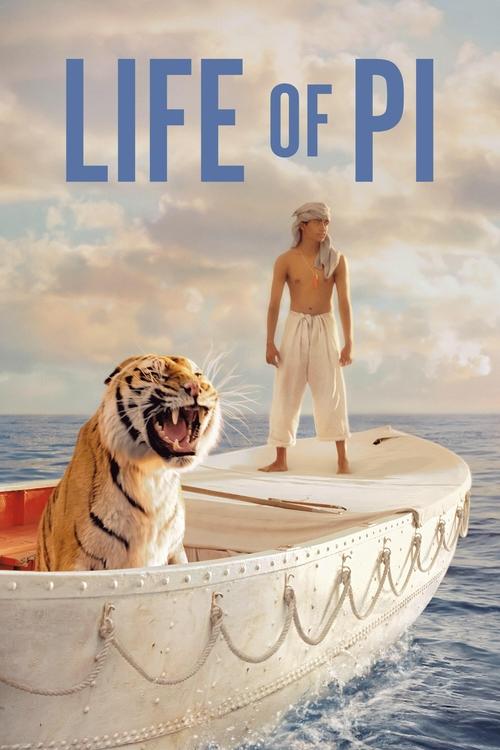
The film's central object is the lifeboat, and the central question of the lifeboat is what to do with the 450-pound animal Pi is sharing it with. Lee has been explicit that Richard Parker is not a tiger in the documentary sense — the production "shot endless videos of how tigers behave"1 and used the footage as reference, but the on-screen animal is engineered to register as both predator and presence. Lee has spoken about Richard Parker as a character the production "devoted our lives to creating," noting that "he came to life" through the layering of CGI on real-tiger reference.6 Reading the second story back across the first, the tiger becomes the part of Pi that survives the lifeboat — the rational, carnivorous, attentive animal that Pi cannot afford to soften and cannot afford to humanise. Martel has framed the relationship explicitly: in the novel's logic, "the tiger could be God" because "Pi says he couldn't have survived without the tiger; it gave him a reason to live."4 The film is more cautious — Lee keeps the symbol read open — but the lifeboat staging makes the argument structural. Richard Parker is the part of Pi that knows what is in the second story, the part that did what Pi cannot narrate in his own voice.
The carnivorous island and the meerkats
The middle of the lifeboat sequence runs aground on an island that should not exist: a floating mass of green algae populated by tens of thousands of meerkats, with freshwater pools that turn acidic at night. Lee compressed the novel's "months" of island time into "one day"1 of screen time, and the compression is itself an editorial argument — the island is not a setting, it is a parable. LitCharts reads the island as "a deceptive form of faith," initially appearing as paradise with docile meerkats and abundant food while concealing a sinister nature: the algae becomes acidic and deadly at night, consuming marine life.5 The Garden-of-Eden reading is exact: Pi discovers a tree bearing human teeth wrapped in a leaf — fruit that names the island's previous occupants. The meerkats register as the population of any easy religion that asks nothing harder than obedience, sleeping in the trees because the rule says so, eating the algae because the algae is provided. Pi's decision to leave the island is the film's clearest single statement on what kind of faith the story is interested in: he chooses, in the LitCharts phrasing, to "set off and perish in search of his own kind than to live a lonely half-life of physical comfort and spiritual death."5 The shallow faith offers food and shelter; the deep faith requires the open ocean.
The ocean as the three-religion amphitheatre
Lee's open-water photography — bioluminescent jellyfish lighting the hull, flying fish raining at noon, a whale breaching beneath a star-mirrored sea — does the heavy lifting that the script delegates to it. Pi spends his Pondicherry boyhood collecting Hinduism, Christianity, and Islam not as competing claims but as overlapping vocabularies, and the Pacific is where those vocabularies are tested. The Hindu iconography (water as Vishnu's body, the lotus floating in the storm) coexists with the Christological framing (the storm as Gethsemane, the surrender-prayer Pi shouts at the typhoon as a Job analogue) and the Islamic register of submission (the Arabic prayers Pi has adopted). The film does not adjudicate between the three. Lee has said the movie "has a philosophical twist to the end, so you have to treat it more like a story-story instead of a survival experience"6 — the ocean is the surface on which the story-story is told, and the three religions are the three languages it is told in. The symbol system closes when the second story arrives: the same Pacific that hosted the tiger also hosted the cook, the sailor, and Pi's mother, and the audience is asked to decide which version of the ocean they were actually watching.
Themes
Drawing on Alex Billington's FirstShowing.net interview with Ang Lee, Rebecca Ford's Hollywood Reporter feature on Suraj Sharma, Jennie Renton's Textualities interview with Yann Martel, and MiNDFOOD's interview with Ang Lee.
The themes of Life of Pi (2012) are three: faith as a chosen narrative rather than an inherited certainty, the coexistence rather than competition of Hinduism, Christianity, and Islam in a single believer, and survival as the structural cousin of storytelling. Read alongside Yann Martel's own framing of the novel and Ang Lee's interview comments on the adaptation, the three themes form a single argument the film carries through every scene from the Pondicherry zoo to the Mexican beach.
Faith as the better story
Martel has summarised the novel's project in three sentences: "Life is a story. You can choose your story. A story with God is the better story."3 The film keeps this scaffolding visible. Pi presents the two accounts to the Japanese investigators without ranking them; the writer is asked which he prefers; Pi thanks him for the answer and says, "And so it goes with God." Martel's own framing of the philosophical move is direct: "If you stumble about believability, what are you living for?"3 and "Love is hard to believe, ask any lover. Life is hard to believe, ask any scientist."3 The film translates this argument into structure rather than monologue. Two stories, same facts. The audience makes the choice the writer makes, and the choice itself — not the verification — is the film's content. Lee has been deliberately permissive on the literal question: "anybody who sees the movie has their take, and it will work."1 What is not permissive is the architecture. The film insists that the choice between the two stories is constitutive of faith, not adjacent to it. To prefer the story with the tiger is, in Martel's logic, to perform the same operation a believer performs when choosing the story with God.
Three religions, one believer
The Pondicherry section establishes a theology that the lifeboat will spend two hours stress-testing. Pi inherits Hinduism at home, sneaks into a Catholic church and drinks the holy water, and adopts Islamic prayer in late adolescence. The film does not stage this as comparative shopping; it stages it as accumulation. Martel has framed the move in his own interviews: "Religion doesn't deny reality, it explains it"3 and "Science and religion don't have to collide — I see them as complementary, rather than contradictory."3 Pi's three-religion practice is the local instance of that broader claim — three explanatory languages, none of them required to falsify the others. The film returns to this thematic line at the dinner-table scene where Pi's father warns that "believing in everything at once is the same as not believing in anything at all," and the film answers him by spending the next 120 minutes proving the opposite. On the lifeboat, Pi shouts in Tamil, prays in Arabic, and crosses himself when the storm breaks. The three registers stack rather than compete. The thematic claim is that a person who has built faith out of three traditions has, in the storm, three vocabularies to pray in — and the storm itself does not care which one is correct.
Storytelling as survival, and survival as storytelling
Lee has identified the film's centre of gravity as a "philosophical twist" rather than an endurance arc: "The movie is not about the survival story. It has a philosophical twist to the end, so you have to treat it more like a story-story instead of a survival experience."6 Read against the second-story revelation, the framing closes a loop. Pi survives 227 days at sea; Pi also survives the telling of those 227 days, and the survival of the telling requires the tiger. Martel has been similarly explicit that the leap is what holds the structure together: "You must make a leap of faith to get the full flavour of life."3 The film's thematic stakes are highest in the moment when Pi finishes the second story and watches the writer choose. The Japanese investigators choose the better story for their report — the one with the tiger — and Pi thanks them. The transaction is the film's working theology: a story believed is a story chosen, and a story chosen is, in this film's grammar, the only definition of faith available. Suraj Sharma — whom Lee cast out of an open call of three thousand because "he looks like Pi and has the innocence he was hoping for in his lead character"2 — carries the thematic load in the second-story scene precisely because the innocence is what makes the alternate telling unbearable. Lee has described his work with Sharma as keeping him "humble" and "grounded"2, and the third-act scene cashes that direction in: the boy who told the first story is the boy who has to tell the second, and the camera holds on his face long enough for the audience to understand why he prefers the tiger.
Final shot interpretation
Drawing on Alex Billington's FirstShowing.net interview with Ang Lee, Rebecca Ford's Hollywood Reporter feature on Suraj Sharma, Jennie Renton's Textualities interview with Yann Martel, and MiNDFOOD's interview with Ang Lee.
The final shot of Life of Pi (2012) is the framing-device interview returned to in present tense: the adult Pi sitting across from the Canadian writer in a Montreal kitchen, the writer choosing the story with the tiger, Pi answering "And so it goes with God," and the camera holding on the writer's face as the implication lands. The shot is the architectural payoff of the whole adaptation — Lee builds the film as a frame story so that the frame can do the work the lifeboat cannot, and the closing minutes are an exercise in giving the audience the same choice the writer is given on screen.
The second story and the parallel cast
Before the choice arrives, the film delivers the lifeboat's alternative version. Pi tells the two Japanese maritime insurance investigators — who have flatly rejected the animal account — a second story in which the zebra is a young Buddhist sailor with a broken leg, the hyena is the French ship's cook, the orangutan Orange Juice is Pi's own mother, and Richard Parker is Pi himself. The cook butchers the sailor for bait and food, kills Pi's mother in front of him, and is killed by Pi in turn. Lee stages the scene in a single shot, the camera close on the adult Pi's face, Irrfan Khan delivering the entire alternate cast as a flat clinical recitation. The film does not show the second story; it makes the audience build it from the first one. Martel's structural intent is exactly this: he has said the two accounts were always meant to share "one set of facts," with the first told "for much longer with a gritty and realistic tone" and the second offered as "an alternate telling based on those same facts."3 The film keeps the architecture and lets Khan's face do the bookkeeping.
Lee's permission and the open verdict
What the closing shot refuses to do is adjudicate. Lee has been explicit about leaving the literal question to the audience: "anybody who sees the movie has their take, and it will work,"1 and the film's design enforces the permission. The investigators in the second story file the report that contains the animals — the "better story" — and on the form they hand Pi at the end of the scene, the relevant line reads that the survivor was accompanied by "an adult Bengal tiger." The film's last formal act, before the kitchen-table close, is the documentary record choosing the version it could not verify. Lee has described his interest in the ending as "what if he wants to hide, what is this, what if the second story is real, what if the first is partially real"1 — a set of conditional probes the film deliberately does not collapse. The framing-device close is engineered to keep the conditionals open and to put the weight of the choice on the writer, and through the writer, on the audience.
"And so it goes with God."
The line Pi delivers after the writer chooses the story with the tiger is the film's load-bearing exit. Martel has framed it as the novel's whole theological move compressed into one exchange: "A story with God is the better story."3 The line works because the film has spent two hours preparing the audience to accept that the choice between the two stories is the same operation as the choice between belief and unbelief. The investigators do not know which story actually happened; the writer does not know; the audience does not know. What everyone in the room knows is which story they prefer. Lee's interview framing of his ending — "how do you wrap it up, without throwing your audience off the track"1 while examining "illusion within the illusion of a movie"1 — names the structural problem the closing shot solves: the film is not asking the audience to believe the tiger, it is asking them to notice what kind of choice they are making by preferring the tiger.
The kitchen-table close
The last sustained image is the Canadian writer's face after Pi has stopped speaking. He has been told that this story will make him believe in God; the story has been told; the choice has been registered. The camera holds on him for a beat longer than the dialogue requires. The shot is doing the same work the second-story compression does — asking the audience to assemble, from the lifeboat the film has just spent two hours filming, the recognition that the choice between the two accounts is the only place faith actually lives. Lee has talked about the production's tiger work as a character the team "devoted our lives to creating"6, and the kitchen-table close is the moment that creation is finally weighed against the alternate cast. The film closes with the writer's small nod, the Canadian autumn light, and the implication that the tiger he has chosen is the only one of the two stories that includes a god. Suraj Sharma — the philosophy student cast at eighteen because Lee was looking for the innocence "he was hoping for in his lead character"2 — is no longer on screen. The film's final face belongs to the listener.
Back to the full movie guide
Plot, cast, where to watch, and similar films — without spoilers.
Open guide →Frequently Asked
What is Life of Pi about?
The story of an Indian boy named Pi, a zookeeper's son who finds himself in the company of a hyena, zebra, orangutan, and a Bengal tiger after a shipwreck sets them adrift in the Pacific Ocean.
Where can I watch Life of Pi?
See the Where to Watch section below for the current streaming, rental, and purchase options in your region.