Spoiler Warning
This article contains major spoilers for Knock at the Cabin (2023).
So what actually happens at the end?
Knock at the Cabin (2023) ends with Eric asking Andrew to kill him so the apocalypse will stop, Andrew firing the shot through tears on the back deck, and the two surviving members of the family — Andrew and Wen — driving to a roadside diner where the radio confirms planes have stopped falling and the plague has receded. M. Night Shyamalan's adaptation replaces Paul Tremblay's bleaker novel ending — in which Wen dies and the family refuses the sacrifice — with a version that asks the audience to accept both that the visions were real and that Eric's voluntary death was the price the world's restoration required.
Plot recap leading into the ending
Knock at the Cabin is a 2023 American apocalyptic psychological horror film co-written, directed and produced by M. Night Shyamalan, who wrote the screenplay from an initial draft by Steve Desmond and Michael Sherman. It is based on the 2018 novel The Cabin at the End of the World by Paul G. Tremblay, the first adaptation of one of his works. The film stars Dave Bautista, Jonathan Groff, Ben Aldridge, Nikki Amuka-Bird, Kristen Cui, Abby Quinn, and Rupert Grint. In the film, a family is vacationing at a remote cabin when they are suddenly held hostage by four strangers who ask them to do something unimaginable.
Symbolism
Drawing on M. Night Shyamalan on changing the ending (Digital Spy via SYFY), Jonathan Groff and Ben Aldridge, DiscussingFilm, and Screen Rant on the Four Horsemen color-coding.
The symbolism of Knock at the Cabin (2023) operates across three interlocking visual systems: the four strangers re-staged as the Four Horsemen of the Apocalypse in shirt-colour-coded reverse, the shaft of light Eric sees in the cabin window that the film offers as either divine vision or concussion hallucination, and the household weapons assembled from farm tools as a deliberate inversion of the conventional home-invasion arsenal. Each functions as both a private image inside the cabin and a public argument about what the film is willing to claim is happening outside it.
The four strangers as inverted Horsemen
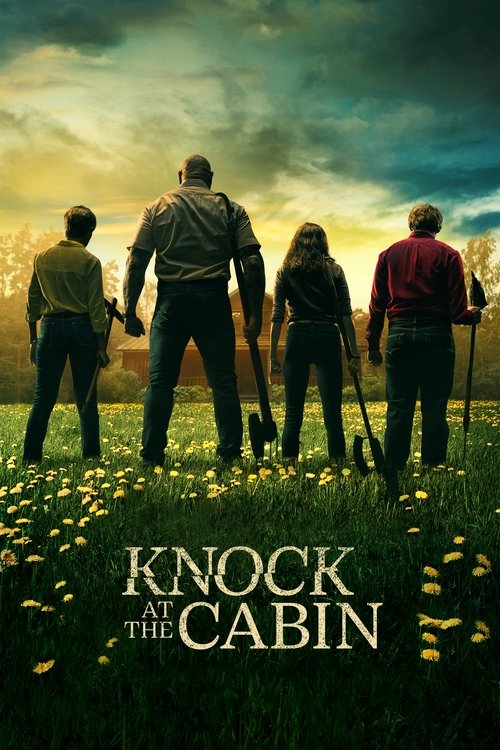
Shyamalan's framing of Leonard, Sabrina, Adriane, and Redmond maps directly onto the four riders of Revelation 6 — Conquest, War, Famine, Death — but reverses the moral charge. Leonard, the second-grade gym teacher in a white short-sleeved button-up, carries the white horse of guidance rather than conquest; Sabrina, the Southern California nurse, wears red but inverts War into healing; Adriane, the Washington line cook, wears black and converts Famine into nurturing; Redmond, the Boston power-company worker, wears the pale-green of Death but is the only one whose violence shows on the surface.4 Each shirt is dressed by costume designer Caroline Eselin-Schaefer with the specific hue of its biblical horse, so the visual catechism of the cabin is built into the wardrobe before the dialogue makes the connection. The makeshift medieval weapons each stranger carries — sharpened farm implements lashed to wooden handles — read on first appearance as a horror-genre signal of menace, then re-read as their assigned implements of an apocalyptic role they did not choose. Bautista's Leonard articulates the inversion explicitly in his exposition scenes: the four are not bringing the apocalypse, they are trying to stop it.
The shaft of light
The film's most-debated single image is the moment Eric, head wound bleeding above his right temple, looks into the kitchen window and reports seeing a figure of light. The script keeps two readings available at the same time: a hallucination caused by a subdural haematoma, and a vision in the same theological register the four strangers have been speaking. Jonathan Groff has described Shyamalan's direction in that scene as deliberately ambiguous: "The thing that he kept telling and reminding us throughout the course of shooting, with Eric being the believer and Andrew being the skeptic, was to play the love in the dialogue and to play the love for each other."3 The light is not, finally, a piece of weather inside the cabin — it is the visual proof Eric needs to consent to his own death, and the camera holds on his face long enough that the audience is asked to choose whether the proof is real or whether Eric's faith has done the work the proof would otherwise have done.
The farm-tool weapons
Production designer Naaman Marshall built each of the four implements as a deliberate refusal of the genre's standard arsenal — no firearms among the strangers, only blades and points wired to wooden handles. The weapons read as religious objects pretending to be hardware: each is gripped on first arrival like a cross, displayed during the killings like a relic, and laid down after each sacrifice in a precise four-pointed pattern on the cabin lawn. Shyamalan's argument is that the strangers are not assailants but officiants. The weapons name what kind of film the cabin is — a chapel, not a battlefield.1 The visual catechism is consistent across every cabin-set shot — costume, prop, and blocking together form a single argument that the audience is being asked to read the cabin as a sacramental space rather than a crime scene, and that the standard genre expectation of an in-house rescue is precisely what the script will not deliver.
Themes
Drawing on M. Night Shyamalan on changing the ending (Digital Spy via SYFY), Paul Tremblay interview, The Daily Beast, and Groff and Aldridge on playing gay dads, HuffPost.
The themes of Knock at the Cabin (2023) are three: faith and proof as competing epistemologies inside a single sealed room, the same-sex family unit as the specific site of an apocalyptic moral choice, and Shyamalan's defection from Paul Tremblay's bleaker novel as a thematic argument in its own right. The film holds all three open across its runtime, and the choices it makes at the kitchen-chair finale resolve them in the direction of belief, sacrifice, and survival.
Faith versus proof
The cabin is built as a closed-circuit argument about what counts as evidence. Eric, the partner with a Catholic-school background, reads the strangers' visions inside a vocabulary the script makes available to him from the opening reel. Andrew, the Boston civil-rights lawyer, reads the same visions as the cover story for a hate crime, and his refusal is the script's load-bearing skeptical voice. Shyamalan refuses the genre's standard cheat of letting one of them be obviously right. Tremblay, the novelist whose book the script is adapting, told The Daily Beast that he first found out about the changes in a phone call: "I first found out in November of 2021, when I had my first phone call with Night," and that his own novel resolved the ambiguity in the opposite direction — toward refusal and uncertainty about the apocalypse itself.2 Shyamalan's film closes the question; Tremblay's book opens it wider. The Daily Beast quotes Tremblay framing his own novel's resolve in his own words: "The idea of rejecting fear and cruelty and hate for a little bit of hope," and "I don't find that hopeful at all" when describing the film's resolution.2 The cabin therefore stages a private argument between two epistemologies and forces one of the two parents to surrender his to keep his daughter alive.
The same-sex family as the apocalyptic axis
Shyamalan and his screenwriters keep the novel's central family structure intact: Eric and Andrew are a same-sex couple who have adopted Wen, and Redmond's pre-cabin history with Andrew is a documented homophobic bar attack. The film answers a question its own premise raises — why this family — by refusing to let the strangers' choice be coincidental. Andrew's case throughout the cabin scenes is that the four have been sent because the family is gay; the script lets him hold that case for most of its runtime before forcing the question to a different conclusion. Jonathan Groff has framed the role inside its political moment: "Gay marriage wasn't even legal when I came out of the closet in 2009, so this feels like the gift of a lifetime."5 Ben Aldridge added the actor's gratitude for the part itself: "I could never have imagined when I left drama school that this would be a possibility. I just feel very grateful."5 The thematic load is that the family chosen to bear the apocalyptic choice is the family historically denied the right to make ordinary family choices — adoption, marriage, the legal protection of the home — and the film stages that load without resolving it into either a redemption arc or a hate-crime conviction.
Shyamalan's break with the novel
Tremblay's book ends with Wen accidentally killed and the parents refusing the sacrifice; the apocalypse is left ambiguous, and the survivors walk into a world whose ending may or may not have started. Shyamalan, speaking to Digital Spy, has been direct about his rejection of that ending: "From go, when this book came to me to produce, I felt very strongly that the story [couldn't] go the way it was written. It just can't go that way for me."1 His change is not a softening — it is a thematic argument. The film's version asks the audience to accept both that the visions were real and that the family's love for each other was the engine that made the sacrifice possible. Tremblay disagrees in print and in the same Daily Beast interview names his own ending "defiantly hopeful" precisely because the family refuses.2 The two endings are the same scene scored to different theology, and Shyamalan's preference for closure over ambiguity is the film's most consequential single creative decision.
Final shot interpretation
Drawing on M. Night Shyamalan on changing the ending (Digital Spy via SYFY), Paul Tremblay interview, The Daily Beast, Jonathan Groff and Ben Aldridge, DiscussingFilm, and Dave Bautista on filming Leonard's death, Variety.
The final shot of Knock at the Cabin (2023) closes on Andrew and Wen at a small roadside diner outside the Pennsylvania woods, a Boston-bound car parked beside them, and the radio inside playing news bulletins that confirm the catastrophes have stopped — planes that had been crashing in waves are flying again, the lightning storms have moved out, the new pandemic strain has receded. Eric is not in the frame. The film holds on Andrew listening, holds longer on Wen watching her surviving father, and cuts to black on the moment the radio plays "Boogie Shoes" by KC and the Sunshine Band — a song that has been seeded twice earlier in Eric and Wen's car-ride memories. The needle drop is the script's signature, and the cut to black is the answer to every question the cabin held open.
The choice to depart from the novel
Paul Tremblay's book closes on a different scene entirely. Wen is dead. Eric and Andrew refuse the sacrifice. The apocalypse may or may not be happening, and the parents drive away with the question unresolved. Shyamalan's break with that ending is not subtle, and he has been clear in print that it was a producer-side conviction from his first reading. "From go, when this book came to me to produce, I felt very strongly that the story [couldn't] go the way it was written. It just can't go that way for me," he told Digital Spy.1 His version replaces Tremblay's refusal with Eric's consent — the moment Eric tells Andrew "shoot me" on the back deck is the cabin's actual climax, and the diner is the chord the script plays once the sacrifice has been made.
Tremblay's counter-reading
The novelist's response to the change has been on the record since the film's release. Speaking to The Daily Beast, Tremblay said the film's ending is darker than his own — a counter-intuitive claim that turns on what each ending costs the survivors. "When I first saw it, I felt so horrified and scared. I felt so sad for Andrew and Wen," he said.2 Tremblay's argument is that a world in which Eric is dead and the visions were real is a world Andrew and Wen now have to live inside as the families who knew the price; his own book's refusal preserved the family at the cost of the world, where Shyamalan's preserves the world at the cost of the family. "I don't find that hopeful at all," Tremblay said of the film's resolution.2 The disagreement is not over taste — it is over which loss the genre is allowed to ask its audience to carry.
What Bautista and Groff do in the close
Dave Bautista's Leonard makes his own sacrifice on the back deck before Eric's — a knife across his own throat that the film stages, Bautista told Variety, in conditions the cast and crew waited days for: "We're sitting out and the weather was nice, and I'm not in a somber mood. I don't feel like dying today, but this is my opportunity to die."6 The performance is the cabin's most controlled single piece of work, and Leonard's death is the moment the film stops being a debate about whether the visions are real and starts being a debate about what Eric and Andrew owe each other. Groff has described the scene of Eric's consent as a single rehearsal: "I remember we rehearsed the scene only once in rehearsal, and it was really intense and very emotional. Then M. Night said, 'Okay, let's leave it. Let's not overthink this.'"3 The film's last image is calibrated to the actors' decision to play the love rather than the theology — Andrew and Wen at the diner, the radio confirming the world has been spared, and the absence of the third chair at the table doing the rest of the work the script does not need to spell out.
The radio bulletin as proof
Shyamalan's final epistemological move is to give Andrew the evidence he refused inside the cabin. The bulletins on the diner radio — the resumed flights, the lifted plague, the calmed storms — confirm in the public register what Eric saw privately in the kitchen-window light. Andrew, the skeptic, hears the proof in the same room as Wen, who has been the negotiator throughout, and the film cuts before either of them has to put what they heard into words. The cut to black is not a flourish; it is the only image the script will allow itself, because every other image would require it to say which version of the cabin's argument was correct, and Shyamalan has built the film carefully enough to let the radio do that work for him.
Back to the full movie guide
Plot, cast, where to watch, and similar films — without spoilers.
Open guide →Frequently Asked
What is Knock at the Cabin about?
While vacationing at a remote cabin, a young girl and her two fathers are taken hostage by four armed strangers who demand that the family make an unthinkable choice to avert the apocalypse.
Where can I watch Knock at the Cabin?
See the Where to Watch section below for the current streaming, rental, and purchase options in your region.