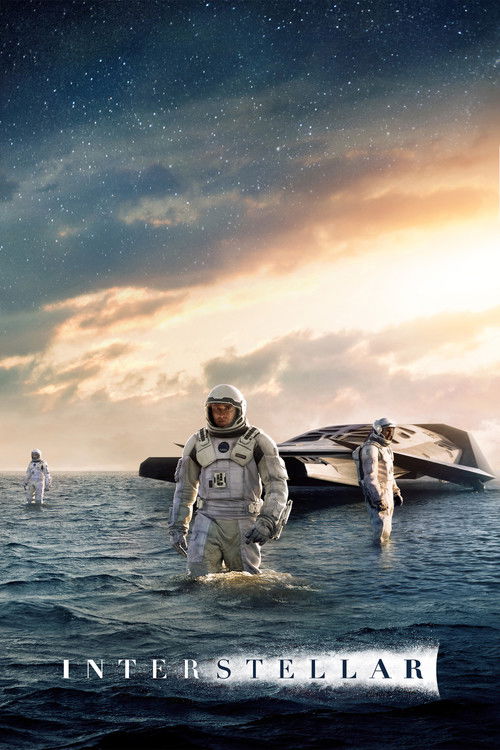
Spoiler Warning
This article contains major spoilers for Interstellar (2014).
So what actually happens at the end?
Interstellar ends with Cooper sacrificing himself into Gargantua's event horizon so the Endurance can reach Edmunds's planet. Inside the black hole he falls into a tesseract — a four-dimensional construct built around the back of Murph's childhood bookcase by far-future humans — and realises he is the 'ghost' Murph has been talking to her entire life. Using gravity as a language he can push across time, he taps out the Morse-coded message 'STAY' to his younger self, then transmits the quantum data TARS scraped from Gargantua's singularity into the second hand of the wristwatch he left her. Adult Murph, now a NASA physicist, finally returns to her childhood bedroom decades later, recognises the ticking watch, decodes the data, and solves the gravity equation Professor Brand could not. Her solution lets humanity lift mass off Earth at scale. The tesseract closes around Cooper and the wormhole spits him back into our solar system, where a NASA rescue team finds him drifting near Saturn. He wakes in a hospital bed on Cooper Station — a cylindrical orbital habitat in Saturn's orbit, built from Murph's equation — and is told he is 124 years old by his own clock. They take him to the deathbed of an elderly Murph, surrounded by her own grandchildren. She tells him no parent should watch their child die, and orders him to go find Amelia Brand, who is alone on Edmunds's world setting up the colony Plan A always pretended to be. The final shot leaves Cooper stealing a ranger ship and pointing it back through the wormhole toward her.
Plot recap leading into the ending
Interstellar is a 2014 epic science fiction film directed by Christopher Nolan, who co-wrote the screenplay with his brother Jonathan Nolan. It features an ensemble cast led by Matthew McConaughey, Anne Hathaway, Jessica Chastain, Bill Irwin, Ellen Burstyn, and Michael Caine. Set in a dystopian future where Earth is suffering from catastrophic blight and famine, the film follows a group of astronauts who travel through space in search of a new home for humanity.
Timeline of the reveal
Mann's betrayal and the slingshot decision
Dr. Mann's distress signal turns out to be a falsified beacon — his planet is uninhabitable, and he tries to murder Cooper to hijack the Endurance back to Earth. After Mann's docking failure tears the module apart, Cooper stabilises a spinning Endurance and the crew is forced into a fuel-starved choice. With Plan A apparently dead on Earth, the only way to reach Edmunds's planet is to use Gargantua's gravity well as a slingshot — and to detach two crew members as ballast to give Brand the delta-v she needs.
Cooper and TARS fall into Gargantua
Cooper detaches his ranger and TARS detaches the lander as the slingshot tightens around the event horizon. The maneuver works for the Endurance — Brand is launched, unconscious, toward Edmunds. Cooper crosses the horizon and free-falls toward what should be his death, transmitting the words "Eureka" and "Don't let me leave, Murph" back to a comms link that will not reach her for decades.
The tesseract and the bookcase
Instead of being crushed, Cooper falls into a tesseract — an architecture that translates time into a navigable spatial dimension. Every instance of Murph's childhood bedroom is rendered as a corridor he can walk through from the back of her bookshelf. He realises the 'they' who placed the wormhole are far-future humans, and the 'ghost' Murph has spent her childhood trying to decode has always been him. He pushes books off the shelf to spell out STAY in Morse, then uses dust to draw the NASA coordinates.
The watch and the quantum data
TARS has recorded the quantum data from inside Gargantua's singularity — the missing piece of the gravity equation Professor Brand has been hiding for decades because there is no Plan A without it. Cooper encodes the data into the ticking second hand of the wristwatch he gave Murph the night he left. Adult Murph, who has come back to the farmhouse to confront her ghost, picks up the watch, recognises that the second hand is stuttering Morse, and runs out of the room shouting 'Eureka.'
Cooper Station and an aged Murph
Cooper's body is retrieved drifting near Saturn by a NASA crew on Cooper Station — a cylindrical O'Neill habitat lifted off Earth using Murph's gravity solution. He has aged barely at all; Earth has aged almost a century. A nurse brings him to the bedside of an elderly Murph, surrounded by her own children and grandchildren. She tells him she always knew he would come back, then sends him away — 'no parent should have to watch their child die' — and tells him to go find Amelia Brand.
Cooper steals a ranger; Amelia builds a camp
Cooper takes a ranger from a hangar bay with TARS and points it back through the wormhole. The film cuts to Amelia on Edmunds's planet — Edmunds himself died before her arrival — alone, unmasked in breathable air, setting up the cryo pods of the surviving Plan B embryos. Cooper is on his way. The credits roll before he arrives.
Character motivations
Cooper's drive across the entire third act is the promise he made the night he left: he is coming back to Murph. The slingshot decision is not heroism, it is arithmetic — he is the lightest pilot, his ranger has the least fuel, and detaching him gives Brand a survivable trajectory. Falling into Gargantua becomes the only way left to keep a promise, and the tesseract turns out to be the universe taking him at his word.
Brand spends the middle of the film arguing for Edmunds's planet on grounds the rest of the crew read as romantic — she loves him, therefore she trusts his data. By the final act, after Mann's betrayal collapses every other option, her argument is the only one left standing. She accepts the slingshot, accepts being launched alone toward a man who may already be dead, and accepts that the Plan B embryos in the lander are now her real responsibility.
Adult Murph spends decades hating the father she believes abandoned her, then spends more decades trying to solve a gravity equation she suspects Professor Brand has been faking. Her return to the farmhouse in the final act is not nostalgia; it is a working scientist coming home to interrogate her own childhood ghost. When the wristwatch starts ticking in Morse, she stops being the abandoned daughter and becomes the person who decodes humanity's escape.
TARS is the only crew member with no genetic stake in the outcome, which makes the robot the cleanest moral actor on board. Its decision to detach itself with Cooper into the black hole is procedural — the math says it works, the math is honest — but it is also the device that lets Cooper survive the tesseract long enough to encode the data. Honesty setting 90 percent, throughout.
On his deathbed Brand confesses to Murph that he solved the gravity equation decades ago and discovered it cannot be solved without quantum data from inside a singularity. Plan A was always a lie; Plan B — the frozen embryos — was always the real mission. His motivation across the film is to keep humanity moving forward by lying to it, and the film treats that as a tragedy rather than a villainy. He dies believing he chose correctly. Murph's solution proves him wrong.
The final scene
The closing scene of Interstellar is split between two planets, and Nolan lets the cut do most of the work. Cooper, freshly told by a dying Murph to go find Amelia, walks through the agricultural module of Cooper Station — a cylindrical habitat in which a baseball game is being played on the curved inner surface of a rotating sky. He passes a recreation of the old farmhouse, preserved as a museum exhibit by NASA, the one his children grew up in. There is a moment where he stops in front of the bookcase. The camera holds on him long enough for the audience to understand what he is looking at: the back of the shelf he spent twenty minutes of screen time pushing books out of from the other side, in a tesseract that no longer exists. He does not touch it. TARS, freshly reassembled with the parts NASA salvaged from his ranger, joins him in a hangar bay. Cooper steals a ranger — the staff barely seems surprised — and the ship lifts off the rotating deck and out into the black. The visual rhyme is exact: he is leaving a home, again, to go find a woman waiting on the other side of a wormhole. The film then cuts to that wormhole's exit. Amelia Brand is on Edmunds's planet, helmet off, breathing the air. Wolf Edmunds is dead — his crashed habitat is visible in the middle distance, marked by a small grave — and she has been alone on this world for what the film implies is many subjective years. She has begun setting up the Plan B cryo pods, the frozen embryos that will become humanity's first off-Earth generation. The shot is wide and quiet. The sky over the planet is pale and unfamiliar. She does not yet know Cooper is coming. Nolan ends the film on her face, then on a ranger silhouetted against the wormhole's lensed star-field, then on credits. He does not show the reunion. The structural argument of the closing scene is that the family Cooper has spent the whole film trying to return to is not the family he had — Murph is gone, Tom is gone, the farmhouse is a museum — but the family that still needs founding, on a world humanity has not seen yet, around a partner the math says is still alive. The promise has been kept. The next promise is being made off-camera.
Symbolism
Drawing on Brand's cockpit speech, Paul Franklin, fxguide, and Kip Thorne, The Science of Interstellar.
The symbolism of Interstellar (2014) is organised around four recurring images that the film treats as load-bearing physics rather than decoration: love as a measurable force, the tesseract as a four-dimensional bedroom, time as an exhaustible resource, and the bookcase as a contact surface between the living and the lost. Read together, these symbols form the argument the film is making about what humans can and cannot send across dimensions they do not yet understand.
Love as a fifth dimension
Amelia Brand's speech in the cockpit — the one Cooper initially treats as sentiment dressed up as science — argues that love is "the one thing we're capable of perceiving that transcends dimensions of time and space," and that it might therefore be an "artifact of a higher dimension that we can't consciously perceive." 1 The film, structurally, is built to make her right. Cooper rejects her argument in the moment because it is being used to advocate for Edmunds's planet, and Cooper reads it as bias. By the third act every other piloting decision he has made has been wrong, and the only one that pans out is the one Brand made on emotional grounds. The tesseract sequence then takes the argument out of dialogue and into engineering: the love Cooper has for Murph is, literally, the only signal in the film that travels across the dimensional boundary. Nolan does not turn love into magic. He turns it into the navigational gradient the construct is built to track. The film's most radical move is to refuse the easy separation between hard-SF physics and the older language of attachment that science fiction usually has to apologise for.
The tesseract as a four-dimensional bedroom
The construct Cooper falls into inside Gargantua is one of the most specific design choices in the film. It does not look like an alien environment. It looks like Murph's childhood bedroom, infinitely multiplied along a time axis, with the back of her bookcase as the only interface surface. Double Negative's VFX team built the tesseract as an "open lattice" of extruded bedroom timelines, partially as a practical set that McConaughey could physically push books through, with the rest extended digitally — a design Paul Franklin describes as turning time itself into a spatial dimension Cooper could walk along. 2 The visual logic is that the far-future humans who built it understood the question Cooper would ask — how do I reach my daughter — and constructed the most direct possible answer: a room she once lived in, rendered as an architecture you can walk through her entire life inside. The tesseract is therefore not a generic higher-dimensional space; it is a love-shaped one. Every wall is a moment Murph and Cooper were apart. The only thing that can cross those walls is gravity. The film's symbolic claim is that the future built this construct because they remembered that the moment Cooper needed was the moment he was leaving — and that the only piece of information that needed to travel back was the data that would let him come home.
Time as the scarcest resource
Interstellar is, more than its space hardware or its black hole renderings, a film about how time costs differently for different people. Miller's planet is the hardest version of the argument: an hour for the away team is seven years for the crew above, and twenty-three years for the children in the radio queue. The film stages the cost as a single, almost unwatchable scene — Cooper watching twenty-three years of video messages from Tom and Murph in real time, aging in his chair as the people he loves get married, have children, and stop sending messages. Time in Interstellar is not a Kubrickian abstraction. It is a budget, and the budget is finite, and the film's symbolic claim is that the cruellest thing relativity does is not bend space but apportion clocks unequally between people who love each other. The endings of all three timelines — Cooper's, Murph's, and Amelia's — only work because the film has been honest about that cost since the launch pad.
The bookcase as the contact surface
The bookcase in Murph's bedroom is the film's most overdetermined object. In the first act it is the haunted shelf where a 'ghost' rearranges Murph's books. In the second act it is the coordinate-bearing dust pattern that points Cooper toward NASA. In the third act it is revealed to be the only piece of the universe Cooper can physically touch from inside the tesseract — the membrane between his daughter's room and his own four-dimensional grave. Nolan films it the same way every time: a slow camera move toward the spines of the books, the dust catching low light, the sound of pages settling. The repetition is symbolic. The bookcase is the place where the film argues that knowledge — written down, preserved, passed forward — is the only thing that survives the time dilation. The books Cooper pushes off the shelf are not random. He chooses titles that point Murph toward what she will need to know. The bookcase is humanity's last contact point because it is the only place in the film where the future and the past agree to leave a message for each other in a language both can read.
Themes
Drawing on Kip Thorne, The Science of Interstellar and Hans Zimmer, Classic FM.
The themes of Interstellar (2014) cluster around three arguments the film makes more openly than most science fiction is willing to: that human survival is a parenting problem, that scientific institutions can lie productively, and that exploration is morally non-optional even when the math says stay.
Survival as a parenting problem
Hans Zimmer's score is built on the same premise: Zimmer has said in interviews that Nolan handed him a one-page brief about a father and his children — not a sci-fi script — and that the four-minute piano-and-organ piece he wrote overnight in response, recorded later on the 1926 Harrison & Harrison pipe organ at Temple Church in London, was meant to carry "the essence of what it meant to be a father" all the way through Cooper's journey. 4 The film opens on a generation that has stopped having children's books about space. Murph's school textbook teaches her that Apollo was a propaganda hoax; the principal sits Cooper down and tells him that humanity now needs farmers, not engineers, and that pretending otherwise is irresponsible. The film treats this as the actual catastrophe — not the blight, but the collapse of the cultural permission to ask big questions. Cooper's argument with the principal is the film's thesis statement: 'We used to look up at the sky and wonder at our place in the stars. Now we just look down and worry about our place in the dirt.' Every subsequent piece of plot machinery is an attempt to reverse that direction of gaze, and the agent of the reversal is consistently parental. Cooper goes to space because his daughter draws him there. Professor Brand keeps the program running for a daughter he sends through the wormhole. Murph solves the gravity equation because she is finishing a conversation with her father. The film argues, against most of the genre's tradition, that the species-level project of survival is enacted at the scale of the family, and that the failure mode is not lack of intelligence but lack of inheritance. The generation that stops telling its children about Apollo is the generation that dooms the next one.
Institutional lying as a kind of love
Professor Brand's confession on his deathbed — that he solved his gravity equation decades ago, discovered it required quantum data from inside a singularity, and concluded that Plan A was therefore impossible — is the moral pivot the film never quite lets the audience finish processing. Kip Thorne, who served as the film's scientific consultant and executive producer, devotes an entire late chapter of his companion book to the climax — Cooper's plunge into Gargantua, the tesseract, and the quantum-data handoff — and is explicit that the gravity equation can only close once that singularity-side measurement reaches the Earth side, which is the structural reason Brand's lie is also the project's only honest road forward. 3 He has been running NASA for decades on a public Plan A and a private Plan B. The public mission was a rescue: bring humanity off Earth. The private mission was a seed: send frozen embryos through the wormhole and let humanity start over on the other side, while the planet he was already abandoning believed it was being saved. Murph's reaction is to call him a liar. Amelia's reaction, later, is more complicated; she understands what her father was carrying. The film does not endorse Brand's deception, but it refuses to flatten it into villainy. The argument is that institutions of long-horizon thinking sometimes survive only by lying to the public about the timetable, and that the moral character of the lie depends on whether it leaves a back door open for the truth to catch up. Murph's solution is the back door catching up. The film is brave enough to let Brand die before that happens, so that the audience cannot judge whether he was vindicated. He lied. The lie worked. He was wrong about the lie being necessary. All three are true at once.
Exploration as moral default
The film's quietest theme is its refusal to take the stay-on-Earth argument seriously, even though it gives the argument's spokesman — Cooper's father-in-law Donald — some of the warmest dialogue in the script. Donald tells Cooper that 'the world isn't short on engineers, it's short on patience,' and the film agrees with the sentence in the moment, then spends the next two hours demonstrating that patience without exploration is just the polite version of giving up. The Lazarus astronauts are the film's argument by example: twelve people who volunteered to be shot through a wormhole alone, with a one-way comms link, on the chance that one of their three planets would turn out to be habitable. The film treats their choice as heroic in a register most science fiction reserves for victory. Edmunds, who never sends a usable signal back, dies on the planet that turns out to be the right one. Mann, who sends the loudest signal back, turns out to have falsified it out of cowardice. The film's theme is that the moral test of exploration is whether you would still volunteer if your signal never came home — and the film answers that test in Cooper's voice in the slingshot scene, when he detaches his ranger and says, with no audience, 'detach.' He does it because there is no other route. The film argues that there is rarely another route, and that the species which figures this out first is the one that gets a Cooper Station.
Final shot interpretation
Drawing on Scott Foundas, Variety.
The final shot of Interstellar (2014) is a deliberate refusal of catharsis. Cooper has been told by a dying Murph to go find Amelia Brand. He has stolen a ranger from a hangar on Cooper Station. The film cuts to Amelia on Edmunds's planet, alone, setting up the cryo pods of the Plan B embryos under a pale unfamiliar sky. Then the camera cuts to the ranger silhouetted against the lensed star-field of the wormhole. Cooper is en route. The film ends before he arrives. Read against everything the previous two hours and forty-five minutes have argued for, the closing image is doing four things at once.
Refusing the reunion
Nolan's most disciplined choice in the closing sequence is the one he does not film. Scott Foundas, reviewing the film for Variety the week of its release, argued that Nolan was operating at the scale of "Hollywood's visionary sci-fi head trips" — naming 2001, Close Encounters, and Gravity — and the final shot is the moment that lineage is most visible, because it answers a head-trip film's third act the way 2001 does, with a trajectory rather than a hug. 5 The reunion between Cooper and Amelia would be the standard closing shot for a movie this length and this register. The film withholds it. The structural reason is that the entire third act has been built around the asymmetry of clocks between people who love each other — Cooper is 124 by Earth's calendar, Murph is dead, and the only person left whose clock still runs at his speed is Amelia, on a planet he has not yet reached. To film the reunion would be to resolve the asymmetry too quickly. Nolan instead lets the asymmetry hold. The final shot keeps Cooper in motion and keeps Amelia in waiting, which is the configuration the film has put them in since the slingshot. The argument is that the love the film has been treating as a fifth-dimensional signal does not need a reunion to be real; it needs only the trajectory.
The recreated farmhouse as the film's quietest reveal
Just before Cooper boards the ranger, the camera lingers on a recreation of his old farmhouse, preserved inside the rotating cylinder of Cooper Station as a museum exhibit. The dust is gone. The corn is fake. Murph's bedroom is roped off behind glass. The bookcase — the same bookcase that was the contact surface between Cooper inside Gargantua and Murph in her childhood — is on display as a historical artifact. The camera holds on Cooper looking at it. He does not touch the books. The film is offering a closed-loop image of itself: the room where the tesseract sent its messages is now a curated piece of human heritage, and the man who sent those messages is standing on the other side of the glass, alive, while the daughter who received them is dead one corridor over. The shot is the film's most economical argument that humanity, having been saved, has begun to forget the cost. It is also the moment Cooper decides to leave. He looks at the museum, then he walks to the hangar.
Amelia under a sky that is finally breathable
The cut to Edmunds's planet is the film's first sustained shot of a habitable world that is not Earth. The light is wrong — pale, slightly blue, casting shadows the audience does not have a reference for — and the air is breathable. Amelia is helmetless. The Plan B embryos are being unpacked. Wolf Edmunds is dead and his crashed habitat is visible in the middle distance as a small marker. The film stages the shot as a foundation rather than a destination. The colour grading is the opposite of the dust-yellow Earth that opened the film. The argument is that the species has, on this single world, in this single shot, finally arrived at the sky it stopped looking up at in the opening scene. Amelia is the first human to breathe an alien atmosphere without engineering between her lungs and the air. The shot belongs to her, not to Cooper, which is part of why Nolan refuses to bring him into it.
The ranger against the wormhole
The film's final composition is the ranger pointed back through the wormhole, the lensed star-field warping around it, TARS in the co-pilot seat. The visual rhyme is precise: this is the same shot the film used when the Endurance first made the crossing, but inverted. Cooper is going back through it from the human side, alone, to find one person. The first crossing was a species-level mission underwritten by an institution that turned out to be lying. The second crossing is a single pilot underwritten by a deathbed promise. The film argues, in the geometry of the shot, that the second crossing is the morally clearer of the two. There is no Lazarus program around it, no Plan A or Plan B, no Professor Brand quoting Dylan Thomas at the launch pad. There is only a man, a robot, a ranger, and a wormhole. The credits roll before he reaches the other side because the film has already made its argument: he is going. He gets there off-camera. The audience is allowed to keep the rest.
Back to the full movie guide
Plot, cast, where to watch, and similar films — without spoilers.
Open guide →Frequently Asked
Who or what are 'They' — the beings who placed the wormhole and built the tesseract?
The film resolves this inside the tesseract itself. Cooper, looking around at the four-dimensional construct, says aloud that there is no 'them' — there is only us. 'They' are far-future humans, descendants who survived because Murph solved the gravity equation, who have evolved or engineered access to higher dimensions and who placed the wormhole near Saturn for their own ancestors to find. The film is therefore a closed time loop: future humans save past humans by building the construct that lets past humans become future humans. Nolan and Kip Thorne were careful to keep the loop inside known general-relativity rules — no information travels faster than light, only gravity bleeds across dimensions — so the resolution is meant to read as physics rather than mysticism.
Why does Cooper age so little while Murph dies of old age?
Time dilation. Three separate effects stack across Cooper's journey: the hour on Miller's planet costs the crew twenty-three years on Earth because of its proximity to Gargantua, the slingshot maneuver around the black hole's event horizon costs more, and the tesseract sequence is, from Cooper's reference frame, a matter of minutes. By the time he is fished out of Saturn's orbit, Cooper has experienced perhaps months of subjective time since leaving Earth, while close to ninety years have passed in the Earth reference frame. He is 124 by Earth's calendar and roughly his own age biologically. Murph, who never left, has aged the full ninety years. The film is unusual in horror-thriller pacing for letting that asymmetry hit at the deathbed scene rather than the launch.
Is the ending actually happy — does Cooper reach Amelia?
The film withholds the reunion deliberately. The last shots show Cooper leaving Cooper Station in a stolen ranger pointed at the wormhole, and Amelia on Edmunds's planet setting up the colony alone. The structural answer is yes, the trajectory closes — Edmunds's world is reachable, the wormhole is still open, the math is sound, and Murph has told Cooper to go. The emotional answer is left open, which is consistent with the film's position throughout that love operates as a navigational signal across dimensions humans cannot yet measure. Nolan ends on the gesture rather than the arrival because the gesture is what the film has been arguing for since Professor Brand quoted Dylan Thomas at the launch pad.
What exactly is in the wristwatch, and why a watch?
The wristwatch holds the quantum data TARS recorded from inside Gargantua's singularity — the missing variable Professor Brand needed to solve the gravity equation that lets humanity lift mass off Earth at scale. Cooper encodes it by manipulating the second hand into Morse-coded patterns, using gravity as the only force that bleeds across the tesseract's walls. The watch is the object the film has been planting since the opening — Cooper gave it to Murph the night he left, told her they would compare times when he got back, and made the promise that lets a ten-year-old hold on to a stuttering second hand decades later. The watch is also the only piece of Cooper Murph keeps in the room when she becomes a scientist. Nolan picks it for the data drop because the audience already knows what it means.
Did Dr. Mann's plan have any chance of working?
No, and the film is quietly explicit about that. Mann's data was fabricated to bring rescuers to a planet he had already discovered was uninhabitable, because his survival instinct overrode his mission training. When he attempts to dock his ranger to the Endurance with a hatch he knows is misaligned, he kills himself in a depressurisation event the film stages as both physically and morally inevitable. Even if the docking had succeeded, the fuel arithmetic still pointed away from Earth — there was never a viable Plan A return without Murph's solution, which had not yet been transmitted from the tesseract. Mann is the film's portrait of what happens to its hero archetype, the lone survivor, when fear is allowed to author the data.