Spoiler Warning
This article contains major spoilers for Glass Onion: A Knives Out Mystery (2022).
So what actually happens at the end?
Glass Onion (2022) ends with Helen Brand — Andi's twin sister, impersonating her since the FedEx puzzle box arrived — burning Miles Bron's Greek-island compound to the ground with a flask of his own hydrogen fuel Klear, taking the Louvre-loaned Mona Lisa with it. Benoit Blanc has already named Miles a fool; Helen's match is the public proof. Miles loses his company, his Senate-candidate friend, his scientist, and his reputation in the time it takes the painting to scorch on the wall.
Plot recap leading into the ending
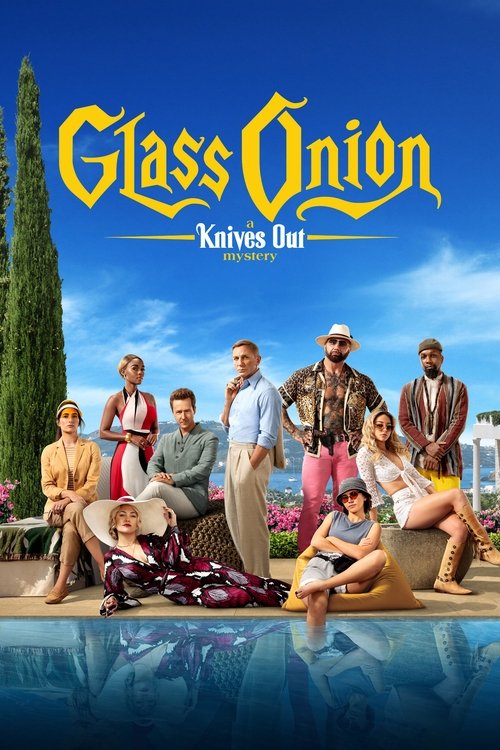
Glass Onion: A Knives Out Mystery is a 2022 American mystery film written and directed by Rian Johnson, and produced by Johnson and Ram Bergman. It is a standalone sequel to the 2019 film Knives Out, and the second installment in the Knives Out film series. Glass Onion sees Daniel Craig return as master detective Benoit Blanc as he takes on a new case revolving around tech billionaire Miles Bron and his closest friends. The ensemble cast also includes Janelle Monáe, Kathryn Hahn, Leslie Odom Jr., Jessica Henwick, Madelyn Cline, Kate Hudson, and Dave Bautista.
Symbolism
Drawing on Natalie Zutter's Den of Geek essay on Miles Bron, Owen Gleiberman's Variety review, and John DeFore's Hollywood Reporter review.
The symbolism of Glass Onion (2022) is built from three load-bearing visual ideas: the layered-yet-transparent onion itself, the borrowed Mona Lisa hanging in Miles Bron's atrium, and the napkin Andi signed at the Glass Onion bar back in Brooklyn. Each one carries a private joke about the difference between looking complicated and being complicated, and each one is calibrated to land exactly when Benoit Blanc's third-act monologue names the trick.
The onion as architecture, not metaphor
The shape is sitting in plain view from the first shot of Bron's island: a transparent dome whose curving panes are arranged in concentric rings, with a single central tower. Rian Johnson built the prop so the audience could see the punchline before the dialogue spelled it out. Blanc's eventual speech names what the building already showed: the layers are visible, and what is underneath every layer is the same thing — Miles. There is no real mystery to solve about Miles Bron's intelligence because his stupidity has been on display from the moment he opened his mouth. Natalie Zutter, writing for Den of Geek shortly after the Netflix release, named the joke directly: "Miles is a goddamn idiot. He uses words wrong, he lacks all social graces, and he has surrounded himself with impressive people and breathtaking art to obscure his own utter ordinariness."1 The set design and the script are running the same gag. The onion's transparency is not a metaphor about complexity; it is a metaphor about the absence of complexity behind a thing that has been engineered to look complicated.
The borrowed Mona Lisa
Miles has pulled strings during the pandemic to take Leonardo's painting from the Louvre and hang it in his living room behind a security screen that drops if the air-quality system fails. The painting functions, inside the film's economy of objects, as the single physical artifact whose meaning Miles cannot generate himself. He needs it on the wall because he needs the room to feel like the room of a man who is in conversation with genius. Variety's chief critic Owen Gleiberman caught the parallel architecture of the film and the host on opening week, calling Miles "a scandalously ambitious, famous, and fatuous tech billionaire" and reading the whole film as "a thriller wrapped in a deception tucked inside a riddle"2 — three layers of glass around exactly nothing. The painting is the most expensive prop Miles owns; it is also the one the film is going to set on fire, because the symbol Johnson needs the audience to register is that the centre of Miles's room has always been borrowed.
The bar napkin
Andi sketched the original idea for Alpha on a cocktail napkin at the Glass Onion bar in Brooklyn. The napkin is the only physical document of the company's authorship. Miles has copies; Andi had the original; the film tracks which version is where as carefully as it tracks the murder weapon. By the time Helen arrives on the island, the napkin has been burned, the partnership agreement has been destroyed, and what is left to prove authorship of Alpha is one woman pretending to be her dead twin. The Hollywood Reporter's John DeFore framed Bron in his September festival review as "a ripped-from-the-headlines tech princeling who gets credit for far more inventions than he should,"3 which is the napkin's argument compressed to a single sentence. The three symbols — the transparent dome, the borrowed painting, the burned napkin — line up as a single thesis about the late-2010s tech-billionaire class: the room is see-through, the genius on the wall is on loan, and the founder's signature is at the bottom of a piece of paper somebody else burned.
Themes
Drawing on Natalie Zutter's Den of Geek essay on Miles Bron, Mark Peikert's IndieWire interview with Rian Johnson, Michael Boyle's SlashFilm piece on the Mona Lisa scene, and David Fear's Rolling Stone review.
The themes of Glass Onion (2022) are three: the stupidity of disruption-talk, the cost of friendship maintained at a billionaire's expense, and grief as the engine that drives Helen's revenge structure through a genre that usually leaves women like her on the sidelines.
Disruption-talk as the language of fools
Rian Johnson has been careful, in interviews, not to call Miles Bron a specific real-world person. Speaking to IndieWire's Mark Peikert in December 2022, Johnson framed Bron as a composite: "There's a lot of general stuff about that sort of species of tech billionaire that went directly into it." He named the cultural register the character was meant to capture: "the intent was to accurately reflect what it's been like to have our heads in the middle of the cultural sphere for the past six years. It's a pretty nightmarish kind of carnival, Fellini-esque inflated reality right now."4 The film's interest is in the language Miles uses — words half-remembered, syntax mangled, every malapropism delivered as a sign of his own depth. Benoit Blanc's mid-film line that names Miles "a fool" is doing the same diagnostic work the title is doing: the man at the centre of the room talks about disruption because he has been told often enough that disruption sounds like intelligence. Speaking on The Filmcast in January 2023, Johnson described the third-act payoff in those terms: "The whole thing at the end was putting his words into action and using them against him, and him being actually horrified because he's full of [it]; he doesn't want actual disruption, he doesn't want the system to be broken."5 The film tests Miles's vocabulary by forcing it to mean something physical, and the vocabulary fails the test.
Friendship as Bron's payroll
The dinner table at the Glass Onion is staged as a reunion. The film insists, scene after scene, that it is a job. Claire Debella is running for Senate on Miles's money; Lionel Toussaint is the scientist Miles needs to sign off on a hydrogen-fuel product Lionel knows is dangerous; Birdie Jay's fashion company is being kept alive by Miles's cash and a sweatshop she cannot afford to admit she runs; Duke Cody is a streamer waiting for the Bron Industries deal he believes is coming. Each one is, in the film's diagnosis, a "Shithead" — the group's own self-deprecating in-joke — because each one has chosen the version of friendship that involves being paid to laugh at the host's bad ideas. Rolling Stone's David Fear, reviewing the film in November 2022, named the resulting tone exactly: a "billionaire tech guru named Miles Bron (Edward Norton, full d-bagging it with gusto)" surrounded by friends whose loyalty looks, on inspection, like a "designer suit thrown over a mannequin."6 Lionel's third-act decision — to side with Helen, against the Klear sign-off he has been bullied toward all weekend — works because the film has been showing the audience the cost of his earlier silences for two hours. Friendship at Bron's table is not the relationship Miles thinks it is; it is the contract everyone in the room has been pretending is not a contract.
Grief as the structural engine
Andi Brand is dead before Helen ever boards the plane to Greece. The film hides that fact from its audience for ninety minutes by hiding it from its detective for ninety minutes; Benoit Blanc has been working with Helen since the puzzle box arrived. Helen carries the case the rest of the way because Helen is the one with something to grieve, and the film's deepest move is to put the engine of its mystery in a woman the genre would normally leave on the sidelines of a richer character's story. Janelle Monáe plays Helen as a kindergarten teacher who has spent a week studying her sister, in the back of a car in Blanc's company, until she can sit at the dinner table the way her sister sat at it. Johnson's third-act monologue gives Miles the worst possible audience for his disruption rhetoric — a woman whose loss the rhetoric has caused. The Mona Lisa burns because the film needs an image proportionate to what Helen has lost, and because, as Zutter observed in Den of Geek, the lesson Helen has finally absorbed is "a billionaire is only as good as other people make him."1
Final shot interpretation
Drawing on John DeFore's Hollywood Reporter review and Michael Boyle's SlashFilm piece on the Mona Lisa scene.
The final shot of Glass Onion (2022) is Helen sitting amid the smoke of Bron's ruined atrium with the burned Mona Lisa hanging behind her, the painting's smile still legible on the singed canvas while the Louvre's security badge melts on the floor. Johnson holds on Helen's face long enough for the audience to register the parallel Miles himself spent the dinner-party scene unpacking: the Mona Lisa's smile, he told the table, was the most ambiguous expression in Western art, a face that could be read as triumph or as sorrow depending on the eye of the viewer. The film's last image is built to be read the same way.
Helen as the Mona Lisa
Speaking about the closing image after the Netflix release, Johnson framed the rhyme directly: "I knew the ending had to be her victory. But I wanted an element of ambiguity. I wanted that same kind of 'Is she smiling? Is she not?' moment for the end. Everything that Miles said while he was talking to everyone about the Mona Lisa smile applies to this person that we've spent the entire movie with."5 The audience is given a woman who has lost her sister and a woman who has just burned down the most powerful man in the room. Both readings are correct simultaneously. The closing shot is the film's argument that revenge is not a clean state, and that the grief Helen is carrying does not disappear because the man who caused it has lost his Senate-candidate, his scientist, and his fortune in the space of an afternoon.
Why the painting had to actually burn
Johnson has been blunt about the structural choice. Discussing an early cut that softened the moment by revealing the burned painting was a copy, he said: "Immediately I was like, 'No, this is pulling a punch, [it's bull], this is dumb. Take it out.'"5 The film's logic required the painting to be real. The "disruption" Miles has been monetising as a brand turns into a thing he cannot live with the moment it costs him something he was using as decoration. Helen's match works because it is the disruption Miles has been telling the world he wants, performed on the one object whose loss he cannot spin. The Hollywood Reporter's John DeFore captured the underlying limit of the genre in his September review: Blanc "is a detective, he has to remind people, not Batman: Uncovering the truth of a crime doesn't mean anyone will pay for what they've done."3 Helen's fire is what the genre's detective cannot deliver. Blanc has named Miles a fool; the napkin and the police interview have failed; the painting is the only court Helen has left.
Catharsis as design
The film ends not on Miles, who is somewhere offscreen, but on Helen — sitting in the wreckage with the smoke clearing, Andi's killer publicly humiliated, the Mona Lisa gone and the Mona Lisa's smile, in Johnson's reading, still hanging in the room on Helen's face. The closing image is the answer to the question the film opened with: what does a real disruption look like, and who has to be holding the match for it to count.
Back to the full movie guide
Plot, cast, where to watch, and similar films — without spoilers.
Open guide →Frequently Asked
What is Glass Onion: A Knives Out Mystery about?
World-famous detective Benoit Blanc heads to Greece to peel back the layers of a mystery surrounding a tech billionaire and his eclectic crew of friends.
Where can I watch Glass Onion: A Knives Out Mystery?
See the Where to Watch section below for the current streaming, rental, and purchase options in your region.