Spoiler Warning
This article contains major spoilers for Get Out (2017).
So what actually happens at the end?
Get Out (2017) ends with Chris kneeling over Rose's dying body as blue and red police lights arrive — except the cruiser turns out to be his friend Rod's TSA car. The reveal completes Jordan Peele's two-hour subversion of the genre's standard outcome for a Black man caught next to a dying white woman, and lets Chris drive away while Rose is left to bleed out at the curb.
Plot recap leading into the ending
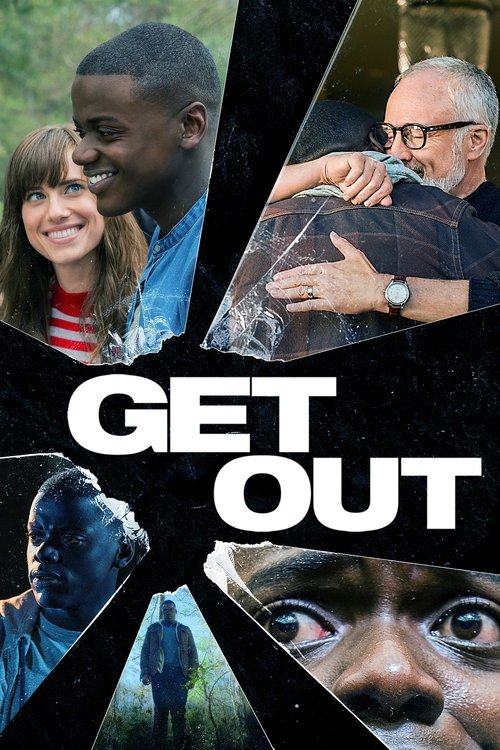
Get Out is a 2017 American psychological horror film written, co-produced, and directed by Jordan Peele in his directorial debut. It stars Daniel Kaluuya, Allison Williams, Lil Rel Howery, LaKeith Stanfield, Bradley Whitford, Caleb Landry Jones, Stephen Root, Catherine Keener, and Betty Gabriel. The plot follows a young black man (Kaluuya), who uncovers shocking secrets when he meets the family of his white girlfriend (Williams).
Symbolism
Drawing on Jordan Peele's UCLA lecture (via Jude Dry, IndieWire), Anya Stanley's Vague Visages essay on the deer motif, and Adaeze Nduaguba's Dartmouth "Feminist Guide to Get Out".
The symbolism of Get Out (2017) is built from three interlocking visual systems: the Sunken Place that names racial silencing, the deer/buck motif that codes Chris as a hunted Black man, and the cotton in the chair armrest that turns slavery's material into Chris's tool of escape. Get Out is built from a small set of repeating visual ideas — the Sunken Place, the deer, the cotton in the chair armrest — each one carrying a private psychological weight and a public political argument at the same time. Read alongside Jordan Peele's own framing of the film, these symbols do not function as decoration; they form the engine that drives the racial horror of the third act.
The Sunken Place
When Missy Armitage taps her teacup spoon and Chris falls through the floor of her sitting room, the film names something Peele has been building since the opening sequence: a state in which a Black person watches their own life happening to them, unable to intervene. In a 40-minute lecture for Professor Tananarive Due's UCLA class "The Sunken Place: Racism, Survival and the Black Horror Aesthetic," Peele described the metaphor in plain terms: "The sunken place is the silencing. It's the taking away of our expression of our art." He has been careful not to fence the metaphor in. "The sunken place is something that exists not just for black people, but for women, for our Latino brothers and sisters, for any marginalized group that gets told not to say what they're experiencing."1 The Sunken Place is therefore not just a hypnotic state Chris escapes; it is the form the film gives to systemic silencing — the audience watches Chris float, eyes wide and mouth open, into the same condition that quietly governs every Black guest at the Armitage garden party.
The deer and the buck
The deer that Rose's car strikes in the first act is the film's most-repeated symbol, and one of the few that takes on two entirely different meanings depending on whose body it is mapped onto. Anya Stanley, writing for Vague Visages a month after release, points out that the antlered male deer carries a specific American slur: "A buck is also a known post-Reconstruction racial slur, used to describe Black men who refused to acquiesce to white authority figures and were considered a menace to white America."3 Dean's rant about deer over dinner — pests, ruiners of property, vermin — therefore reads not as eccentric trophy-hunter dialogue but as a parallel argument about Black men, delivered in front of one. Adaeze Nduaguba, writing for the Dartmouth "Feminist Guide to Get Out," makes the parallel literal: "The deer serves as a motif for black men, in representing how they are perceived to ruin neighborhoods, how unassimilated they are and how they need to be locked up."4 When Chris drives the antlers of the mounted buck through Dean in the basement, he is not improvising a weapon; the film is closing a circuit it opened ninety minutes earlier. As Stanley puts it, "The antlers are both a literal and a metaphorical implement of resistance, and their indication is clear: Chris is not a wild beast to be tamed."3
The cotton in the armrest
When Chris digs his fingers into the leather chair and pulls out a small wad of cotton — the only material between him and another trip to the Sunken Place — Peele inverts a symbol most American horror would avoid touching. Stanley reads the cotton as the same material Black bodies were forced to pick under slavery, repurposed here as the literal blockage that lets a Black man hear himself think.3 The shot lingers on Chris's fingertips because Peele wants the audience to register both the texture and the inheritance: the substance that once silenced his ancestors becomes, in Chris's hands, the substance that breaks the silencing. The three symbols — Sunken Place, antler, cotton — work as a single argument: the same materials that built and maintained American racial subjugation are turned, by Chris's hand, into the tools that get him out.
Themes
Drawing on Jordan Peele's UCLA lecture (via Jude Dry, IndieWire), Jordan Peele's Den of Geek retrospective on the original ending, Adaeze Nduaguba's Dartmouth "Feminist Guide to Get Out", and Peter Debruge's Variety review.
The themes of Get Out (2017) are three: white liberal racism as the actual horror, the post-racial lie of the Obama era, and the Order of Coagula as a refashioning of older slavery logics. Three themes hold Get Out together once the Sunken Place trapdoor opens: white liberal complicity as the actual horror, the post-racial lie of the Obama years, and the Order of Coagula as a refashioning of older property logics.
Liberal racism as the real horror
Variety's chief critic Peter Debruge identified the film's target on opening week, in a review that landed before the bingo-auction reveal had become common cultural property. "The crazies are the liberal white elite, who dangerously overestimate the degree of their own enlightenment," Debruge wrote, naming the Armitages and their Sunday-afternoon guests as the genre's actual monsters.5 Dean's volunteered "I would have voted for Obama a third time" lands in the early dinner scene with a comic edge, but the film stages every subsequent micro-violation — Jeremy's groping headlock, Logan's stiff handshake, the guest on the porch who squeezes Chris's bicep — as part of the same complacent register. Debruge framed the Coagula procedure itself as not a fantasy element grafted onto a satire but "a new way that white people have found to perpetuate the peculiar institution of slavery," which functions as the film's thesis statement in a single clause.5 The Armitages are not racists who don't know they are racist; they are racists who have been told often enough that they are not.
The post-racial lie
Peele has located the film inside a specific moment. In a retrospective for Den of Geek, he described the project as written "in the Obama era," when American culture was operating under what he names a "post-racial lie" — a cultural cover for the racism he says was, in those same years, "still simmering underneath the surface."2 The film does not argue that the Obama presidency caused the Armitages; it argues that the cultural narrative around the Obama presidency was the cover that let the Armitages keep operating. Every cordial exchange Chris weathers at the garden party is calibrated to the public claim that race no longer functions in white-American life. The film answers the claim by showing what happens beneath it: a private auction, a basement procedure, a buyer who wants Chris's eyes specifically.
Coagula and the silencing of the body
Connected to the first two themes is Peele's universal-rather-than-particular framing of the Sunken Place. Speaking at UCLA, he has been explicit that the metaphor extends beyond a single demographic — to women, to Latino communities, to any marginalised group, in his framing, "that gets told not to say what they're experiencing" — and that the silencing is structural rather than individual: "It's the system. It's all these cogs in the wheel that sort of keep us where we are."1 Coagula reads inside this frame as the most literal possible image of that system: not a metaphor for being silenced but an operating room in which the silencing is performed at the level of the cervical spine. The film follows Logan, Walter, and Georgina because it needs to show three Black bodies in different stages of the procedure — three demonstration cases for what happens when consciousness is allowed to remain but agency is removed. Adaeze Nduaguba's reading sharpens this connection: "Like the black people Rose hunted and seduced, Dean's favorite bits of blackness were given new life as decorative trophies."4 The Armitages are not destroying Black men; they are wearing them. That is the horror Peele built the Sunken Place to name, and it is the same horror the deer trophy on the basement wall has been pointing at since the road-collision scene.
Final shot interpretation
Drawing on Jordan Peele's UCLA lecture (via Jude Dry, IndieWire), Jordan Peele's Den of Geek retrospective on the original ending, Peter Debruge's Variety review, and Nicole Symmonds's Sacred Matters Magazine essay.
The final shot of Get Out (2017) is a controlled reveal: the blue-and-red police lights washing across Chris kneeling over Rose's bleeding body read as a fatal arrest for a Black man caught next to a dying white woman, then the cruiser door opens onto Rod's TSA vehicle, and Chris is allowed to drive away while Rose is left to die on the curb. The closing minutes of Get Out are organised around a single visual sleight-of-hand: blue and red police lights wash across Chris's face as he kneels over Rose's bleeding body, the audience reads the scene as the standard American outcome for a Black man caught next to a dying white woman, and then the cruiser door opens onto Rod, TSA badge and all. To read what that switch does, it helps to read the version of the ending Peele filmed first.
The buried original ending
In Peele's original cut — discussed at length with Den of Geek — the police arriving at the curb were real officers. Chris is arrested. Six months later Rod visits him through bulletproof prison glass; Chris tells his friend he is "good" because he "stopped it," and Rose's family is reduced to a closed file. Peele's reasoning for filming that version is laid out in his own words: "I wrote this movie in the Obama era and we were in this post-racial lie. This movie was meant to call out the fact that racism is still simmering underneath the surface, so this ending to the movie felt like it was the gut punch that the world needed, because something about it rings very true."2 The original was the demographically correct ending — the one a US criminal-justice data table predicts for the scenario the camera is staring at.
Why Peele changed it
Peele has been clear that the change was reactive, not aesthetic. Test screenings happened in 2016, and the post-Trayvon-Martin cultural moment was no longer willing to absorb another image of Black death rendered as moral statement. The shift was about the audience's available emotional bandwidth, not the argument's truth. As Peele has put it: "With each problem, there's not one solution, there's not two solutions, there's an infinite amount of great solutions. That includes the ending."2 What audiences finally saw was the second of those solutions — survival as the response the moment needed even if not the one the demographics predicted.
What the TSA-car reveal actually does
Nicole Symmonds, writing for Sacred Matters Magazine, argued that the theatrical ending was not soft, it was correct. "Chris wasn't supposed to get away with slaying this solidly white upper middle class family," she writes, drawing attention to the genre and historical contract Peele violates by letting Chris live.6 The reveal that the police car is Rod's TSA vehicle is, in Symmonds's read, "a signal of collective relief and gratitude for being able to see what it looks like when someone truly makes a black life matter."6 The image the audience is finally given — "two black men who survived against all odds" driving past Rose, who is left to die unattended — re-orients the entire genre's centre of gravity. Symmonds frames this as Peele granting "viewers, especially black ones, the kind of reprieve we've been hoping for."6
Catharsis as design, not concession
Peter Debruge's Variety review captured the audience's response on opening weekend in one sentence: "audiences actually cheer as he gorily eliminates the white people who stand in his way."5 The cheering is what the original ending could not earn, and what Peele's second cut was engineered to release. The final shot is not a happy ending in the Hollywood sense; it is a hostile reclamation of the genre's closing image. The dying body in frame is Rose Armitage's. The two men driving away are Chris and Rod. The film closes on the side of survival rather than tragedy — not because the world has changed but because the film has decided, for these two characters, on this night, to let them out. The Sunken Place, the silencing Peele framed at UCLA1 as the engine of the film's horror, finally has its negative image: a Black man at full volume, in motion, with a witness who knows what happened to him.
Back to the full movie guide
Plot, cast, where to watch, and similar films — without spoilers.
Open guide →Frequently Asked
What is Get Out about?
Chris and his girlfriend Rose go upstate to visit her parents for the weekend.
Where can I watch Get Out?
See the Where to Watch section below for the current streaming, rental, and purchase options in your region.