Spoiler Warning
This article contains major spoilers for Fight Club (1999).
So what actually happens at the end?
Fight Club (1999) ends with the Narrator shooting himself through the cheek to kill Tyler Durden, the alter ego he has been hosting since his insomnia broke him. The bullet leaves the Narrator alive — Tyler's body slumps onto the high-rise floor with the exit wound — and Marla is hustled into the building by Project Mayhem foot soldiers who still believe they answer to Tyler. The Narrator dismisses them, sends them away, and meets Marla at the bank of windows just as the demolition charges Tyler planted in the basements of the credit card companies begin to fire. Skyscrapers across the financial district collapse in sequence while the Narrator holds Marla's hand and tells her, half-apologising, that she met him at a very strange time in his life. His closing line — "You met me at a very strange time in my life" — sits over a final two-shot of the Narrator and Marla watching the buildings come down, the Pixies' "Where Is My Mind?" playing under the destruction. The credit-card debt records inside those buildings are, in Tyler's plan, what reset American consumer civilisation back to zero. The Narrator does not stop the explosions. He kills the part of himself that authored them, then chooses to stand next to the only person who ever saw him without his Tyler-mask. A single-frame insert of a pornographic image — a Tyler signature that flashes during projection booth gags earlier in the film — is spliced into the final reel just before the cut to black, a last wink that the Narrator's Tyler-self has not necessarily been put fully to rest.
Plot recap leading into the ending
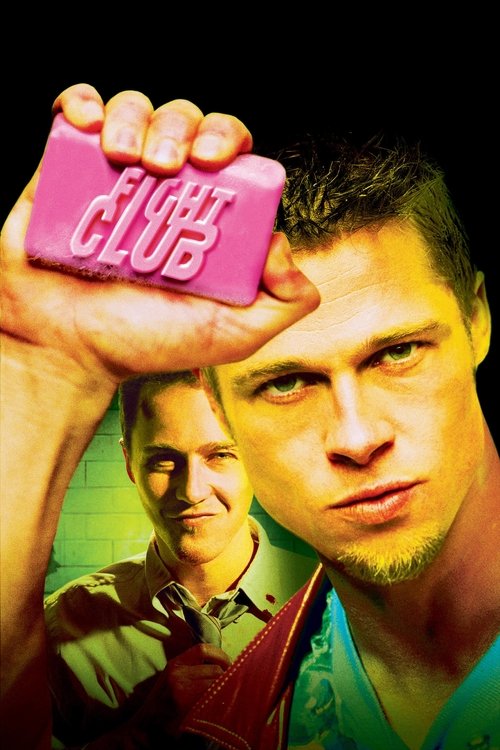
Fight Club is a 1999 American film directed by David Fincher from a screenplay by Jim Uhls. Based on the 1996 novel Fight Club by Chuck Palahniuk, it stars Brad Pitt, Edward Norton, Helena Bonham Carter, Meat Loaf, and Jared Leto. In the film, an unnamed narrator (Norton) discontented with his white-collar job, forms a "fight club" with soap salesman Tyler Durden (Pitt), and becomes embroiled with an impoverished but beguiling woman, Marla Singer.
Timeline of the reveal
Rooftop confession
The Narrator finally confronts what the audience now sees: he is Tyler. On the parking garage rooftop the two figures resolve into one man, and Tyler explains that he is what the Narrator has been afraid to become.
Marla taken from the building
Project Mayhem space monkeys deliver Marla to the high-rise on Tyler's standing orders. She arrives furious, certain the Narrator has been lying to her for months about who he is.
The cheek shot
The Narrator presses the pistol under his chin, angles it through his cheek, and pulls the trigger. The wound is real on his face; Tyler's body collapses with the matching exit wound across the room.
Dismissing the space monkeys
Bandaged and bleeding, the Narrator gives his first order as himself rather than as Tyler — telling the Project Mayhem soldiers to release Marla and leave the building. They obey without question.
The buildings collapse
Through the windows, the demolition charges on the credit card company towers fire in sequence. Tyler's plan executes itself with or without him. The Narrator watches but does not intervene.
"You met me at a very strange time"
He takes Marla's hand. His apology is small and exact. "Where Is My Mind?" comes up on the soundtrack. A single frame of Tyler's pornographic insert flashes through the projection before the cut to black.
Character motivations
His arc resolves into a paradox: he has to kill Tyler without losing the part of himself that learned, through Tyler, to feel anything at all. The bullet through the cheek is not a suicide attempt but a targeted exorcism — he aims through the dissociated half of his own skull so the body can keep walking. His final gesture is to hold Marla's hand instead of leading her out, choosing presence over rescue. He does not stop the bombings because, on some level, he still wants the world Tyler promised.
Tyler is the Narrator's projection of every quality he has been told to suppress: physicality, charisma, refusal to consume. By the third act Tyler has organised his own succession, leaving Project Mayhem soldiers who can carry out the plan if the host body removes him. Tyler's last move in the film is to put the gun in the Narrator's mouth — a wager that the Narrator does not have the nerve to fire. He loses the bet, which is how he wins. The plan executes anyway, and Tyler dies as a martyr inside his own host.
Marla spends the final act trying to figure out whether the man in front of her loves her or has been gaslighting her on an industrial scale. When she is delivered to the building she is ready to walk out on him. She stays because the Narrator, for the first time, behaves like a single coherent person — apologetic, present, not switching modes. Her presence in the closing two-shot is not forgiveness; it is curiosity about whether the man she just met is going to last beyond the lobby.
The space monkeys have moved beyond Tyler as a person and treat him as a doctrine. By the rooftop scene they will obey any voice that speaks with Tyler's authority — which is why the Narrator can stand them down once he has killed the alter ego. Their motivation is the cleanest in the film: they want the credit records gone, they want a flat civilisation, and they have surrendered every individual judgment to get there.
The final scene
The closing scene of Fight Club is staged inside a glass-and-steel observation window on an upper floor of one of the credit card company buildings that has not yet been targeted. The Narrator stands with a fresh through-and-through cheek wound; Marla stands next to him, still being walked back from rage into something quieter. He has dismissed the last of the space monkeys, who left a roll of medical gauze and a confused half-loyal look on the way out. The room is otherwise empty. The camera holds them in a flat two-shot for almost the full length of the closing image, refusing the impulse to move in for a kiss or pull back for a hero pose. Fincher keeps the framing parental, even clerical, like a wedding witnessed by no one. Through the window, the demolition charges Tyler planted in the foundations of the financial district begin to fire. The buildings collapse downward in a controlled vertical fall, one after another, without dust storms or screaming. There are no people in the windows of the falling towers because Tyler timed the detonations for after-hours — a detail the film stresses earlier in the parking-lot speech, and which the closing sequence quietly preserves. The Narrator does not pretend to disapprove. He does not run for a phone. He has chosen his side by killing the half of himself that wrote the plan, and now lets the plan walk away from him. The Pixies' "Where Is My Mind?" begins almost immediately as the first tower starts to drop, and the song's stop-start guitar riff has been retroactively turned, in the public imagination, into the sound of the film's ending. The Narrator's last spoken line — "You met me at a very strange time in my life" — is delivered without irony and without tenderness; it is closer to the formal phrasing of a first date than the punchline of an anarchist romance. Marla does not answer. She holds his hand. A single frame of the same pornographic insert Tyler spliced into the family-film prints during his projection-booth job earlier in the movie flashes onto the screen just before the cut to black. The gag is delivered without context, without a Tyler appearance, and without any acknowledgment from the Narrator. It is the film's last refusal to give the audience a clean exorcism: the host body may have killed the alter ego, but Tyler's signature still gets to be the last thing the projector throws at the screen.
Symbolism
Drawing on David Fincher to Shannon McDonagh, Euronews.
The symbolism of Fight Club is built from a tight set of repeating objects and routines that map a single argument about late-1990s American manhood onto the visual surface of the film: the IKEA catalogue interior, the soap, the basement basement-bar with its concrete pillars, the projection-booth splice, and the body itself as a piece of property that can be wrecked or upgraded. Each of these symbols does double work — it describes the Narrator's interior life and it indexes a wider economic system the film is trying to diagnose.
The IKEA-self apartment
The first sustained image of the Narrator's life is his condo, presented as a literal product catalogue: prices and SKUs float over the furniture as the camera pans, turning his living room into an order form. The catalogue interior is the visual signature of what Fincher and Uhls treat as the Narrator's pre-Tyler self — a man who has been assembled by purchase rather than by choice, whose taste, posture, and self-image are mail-order. When Tyler blows the apartment up, the film blows up not a building but a vocabulary. The grid of identical condos seen from outside the burning unit makes the point at scale: this is not one man's furniture problem, it is a housing block of men furnished in the same idiom. The IKEA self is therefore not a costume to be removed; it is the architectural metaphor the film uses to argue that consumer interiority and personal interiority have, in the late nineties, merged into the same shopping list.
Soap
Tyler's day job — making and selling artisanal soap — is the film's most layered piece of object symbolism. The soap is rendered, on camera, from human fat liposuctioned out of the very class of customers it will be sold back to. The image is repeated until the joke stops being a joke and becomes a thesis: the consumer economy in the film literally feeds on the bodies of the wealthy and resells those bodies to them at a markup. The pink bars stacked in Tyler's kitchen carry both the slapstick of the prank and the gravity of the critique. Soap is also the surface metaphor for purification, which Project Mayhem turns into a moral programme: the bombing of credit-card buildings is, in the film's symbol-grammar, a hygienic act. The audience is asked to see Tyler's product line and Tyler's politics as expressions of the same gesture — strip the fat off the system, render it down, sell it back in a shape the system cannot use.
The basement
The unfinished concrete basements where the fight clubs meet are the film's counter-architecture to the IKEA condo. They have no furniture, no SKUs, no overhead light source warmer than fluorescent, and they are accessed through stairwells that look the same in every city the franchise spreads to. The basement is not a place the men go to express themselves; it is a place where the apparatus of self-expression — clothes, names, jobs, taste — is suspended for ninety minutes. Fincher shoots these spaces in cold green-grey so that bruises and blood read as the only colour available, the way feeling becomes the only colour available in a life that has otherwise been mood-boarded by Restoration Hardware. The basement also rhymes, by the end of the film, with the basements of the credit-card buildings being demolished in the final shot. The men who started in concrete rooms below office buildings finish by collapsing the office buildings on top of those rooms; the basement, in the film's symbolic economy, eats the tower.
The projection-booth splice
Tyler's other job, splicing pornographic frames into family films, is the structural symbol the entire movie is built on. The single-frame inserts of Tyler that flash in early reels before the audience knows who he is — a glimpse beside the photocopier, behind the doctor, at the end of a hospital corridor — are the same gesture Tyler describes performing professionally. Fincher uses Tyler's job to teach the audience how to watch the film: there is something subliminal in here that you will only consciously register on a rewatch. The closing pornographic frame is the symbol returning to its source; the film signs off with the same trick Tyler used to introduce himself. Fincher himself, defending the film's ending against later attempts to alter it, has framed the integrity of that closing gag as load-bearing: "If you don't like this story, why would you license this movie? It makes no sense to me when people go, 'I think it would be good for our service if we had your title on it... we just want it to be a different movie.'"4
The body as commodity
Every fight in the basement is filmed with attention to the body as something that can be defaced and that defacement makes more valuable, not less. Tyler's chemical burn on the back of the Narrator's hand — a kiss-shaped scar made from lye — functions like a brand on livestock and like a tattoo on a member, simultaneously. By the time the Narrator stands in front of his boss with a bloody face and demands a severance package, the bruises are functioning as a financial instrument. The film's symbolism keeps insisting on the same swap: the body taken back from the catalogue economy becomes a tool the catalogue economy does not know how to price.
Themes
Drawing on Roger Ebert's RogerEbert.com 1999 review.
Fight Club is organised around four interlocking themes that arrive in roughly the same order the Narrator discovers them: masculinity inside consumer collapse, the IKEA-self versus the Tyler-self, Project Mayhem as a study in how anti-consumer politics slides into fascism, and the structural unreliability of a first-person narrator who turns out to be two people. Each theme is staged across the runtime rather than spoken; the screenplay is unusual in late-nineties American cinema for trusting the audience to read its argument out of behaviour rather than out of speeches.
Masculinity in consumer collapse
The film opens on a generation of men whose fathers, in Tyler's later monologue, are either absent or unreachable, and whose work has been emptied of physical content. The Narrator is a recall coordinator for a major car manufacturer, calculating whether it is cheaper to fix a fatal design flaw or to settle the lawsuits — a job that is white-collar in posture and homicidal in content. The film's first theme is that this combination has produced a male population that cannot locate itself: the labour is abstract, the products are interchangeable, and the bodies are intact but unused. Fight clubs are presented as a remedial education programme. Men come to them because they have stopped being able to feel where they end and the corporate surround begins, and a punch to the jaw, however crude, restores the question by answering it. The film does not romanticise this education — it shows men with their teeth in their hands — but it does take seriously the diagnosis that a certain kind of male body, in this economy, no longer knows what it is for.
The IKEA-self versus the Tyler-self
The film's central psychological theme is the wager between two organising principles for the same life. The IKEA-self is competent, sleepless, comparatively safe, and emptied out; the Tyler-self is reckless, charismatic, violently certain, and entirely unsustainable. Neither is the answer. The Narrator's mistake for most of the runtime is treating Tyler as the solution rather than as the second symptom; the film's argument, made over its third-act recut, is that the dissociation between the two selves is itself the disease, and that any version of a flourishing life would have to integrate the parts of him that built and bought the condo with the parts of him that wanted to burn it down. The final shot — the Narrator holding Marla's hand while Tyler's plan finishes executing — is the closest the film gets to dramatising this integration: he has stopped being Tyler full-time without pretending Tyler never happened.
Project Mayhem as fascism critique
Once the basement fight clubs scale into a national franchise, the film deliberately changes register. The men shave their heads, surrender their names, wear identical black, and chant in unison. Tyler's lieutenants begin issuing rules that no one is permitted to question. The political content of Project Mayhem is left ambiguous on the surface — Tyler talks anti-consumerism, but the visual grammar is straightforwardly fascist — and the film treats this ambiguity as the point. Roger Ebert read the resulting tone as the central provocation of the picture, calling it "the most frankly and cheerfully fascist big-star movie since Death Wish"1 and warning that "audience will like the behavior but not the argument."1 Anti-consumer rage, the screenplay argues, does not have a built-in left or right; it can be poured into any container that gives it a uniform and a hierarchy, and the container nearest to hand in late-1990s America is a paramilitary cell with a charismatic male leader. The death of Bob — Robert Paulson, the testicular-cancer support-group hugger whose name then becomes a chant — is the film's clearest statement that this slide has costs the men inside Project Mayhem cannot recognise from inside the formation.
The unreliable narrator structure
The fourth theme is the one that retroactively rewires every previous theme. The third act reveals that the Narrator has been hosting Tyler the entire time, which means every scene the audience watched as a two-hander has to be re-screened as a single-occupancy event. Fincher and Uhls treat this not as a twist for its own sake but as a thematic device: a film about a man who has lost the ability to locate himself inside a consumer economy is told from inside the dissociation it diagnoses. The audience is put in the same epistemic position as the Narrator until the final reels, when the film teaches its viewers, the way Tyler taught the Narrator, that the camera has been splicing one person out of itself frame by frame. Once the structural unreliability is named, the film's claims about masculinity, consumption, and political organisation are all forced through the filter of a speaker who has, all along, been an unreliable witness to his own life — which is the film's last and most uncomfortable theme: that this entire diagnosis comes from a man whose grip on the diagnosis is, by his own admission, partial.
Final shot interpretation
Drawing on Chuck Palahniuk to Patrick Brzeski, The Hollywood Reporter and Chuck Palahniuk to William Earl, Variety.
The final shot of Fight Club is a two-shot of the Narrator and Marla framed at a high-floor window, watching the demolition charges Tyler planted in the credit-card company headquarters fire in sequence across the financial district. The composition is symmetrical to the point of religious portraiture — two figures, one window, a city collapsing as backdrop — and Fincher refuses to release the audience with a kiss, a swell, or a reaction shot. He gives them a hand-hold, the Pixies' "Where Is My Mind?", a closing line of disarming smallness, and one last subliminal frame of Tyler's projection-booth signature.
The composition: parental, clerical, deliberately unsexy
Fincher stages the closing two-shot the way a courtroom artist would draw a witness: side-by-side, eye-line forward, no contact except the hand-hold that the camera notes without underlining. The Narrator's face is freshly wounded — a bandage over the through-and-through cheek shot — and the wound is on the side of his head facing the camera, so that the audience cannot read the image as recovery. The framing rhymes deliberately with the very first images of him in the condo, where he was photographed against an interior that the camera catalogued like an order form. Here, the interior is a glass wall onto a city in controlled collapse. The grammar is the same: a man and his surroundings in a single inseparable frame. What has changed is who is standing next to him and what those surroundings are doing.
"You met me at a very strange time in my life."
The closing line is calibrated against an entire third act of Tyler-style aphorism. Tyler's signature mode of speech is the bumper-sticker imperative — "the things you own end up owning you," "self-improvement is masturbation" — and the final line is exactly the opposite register: small, conversational, the formal phrasing of a first date. The film hands its closing aphorism not to Tyler but to the half of the Narrator that survived him. He apologises for the circumstances of meeting Marla without retracting the meeting itself. Marla does not respond; the script gives her the dignity of silence in the face of an apology that would not be improved by being received out loud. The line has been read in the years since the film's release as one of the most quoted closing sentences in late-nineties American cinema, and it works because it is the smallest thing the Narrator has said in two hours.
The buildings come down
Behind the two-shot, the demolitions execute in roughly the order Tyler described in the parking-lot speech earlier in the film: the foundation charges fire, the buildings collapse downward in a vertical fall, and the dust cloud climbs only at the end. Fincher resists the spectacle vocabulary of disaster cinema. There are no people in the windows of the falling towers because Tyler timed the bombings for after-hours; there are no first-responder cuts, no news anchors, no reaction shots of bystanders on the street. The collapse plays out as if it were a model demonstration, almost emotionless. The film's refusal to dramatise the destruction is part of the argument: Tyler's politics were always going to render the violence as engineering, and the camera honours that framing one last time even as it ends the relationship with Tyler. Chuck Palahniuk, the novel's author, has registered one objection to this design — the on-screen countdown that pressures the sequence — telling William Earl at Variety: "I wasn't a big fan of the ticking bomb, that counting down clock near the end."3 The novel ends differently: Palahniuk has noted that the Chinese censorship cut, by closing on the Narrator in psychiatric custody, "aligned the ending almost exactly with the ending of the book, as opposed to Fincher's ending, which was the more spectacular visual ending."2
"Where Is My Mind?" as soundtrack rhyme
The Pixies' song was placed at the end of the film by Fincher rather than at the request of the band; the track had not yet, in 1999, become a closing-credits cliché, and its stop-start guitar opening over the first tower's collapse has since been retroactively absorbed into the public imagination as the sound of the film's ending. The lyric — a man asking, in falsetto, where his mind has gone — sits exactly on top of the film's thesis without naming it. The Narrator has just performed the most literal possible act of asking that question: he put a bullet through the side of his head that was hosting another self, and the song asks the same question back over the credits.
The pornographic-frame splice
The last gesture the film makes is the one most viewers miss on the first watch. A single frame of the same pornographic insert Tyler bragged about splicing into family films during his projection-booth shifts is cut into the final reel just before the cut to black. The audience perceives it as a flash without identifying it. Fincher has confirmed in retrospective commentary that the frame is intentional and that it is meant to function as Tyler's signature on the bottom of the film — the audience watched a Narrator kill the dominant alter ego, but the very last image the projector throws is a Tyler tag. The film therefore refuses to give the audience a clean exorcism. Tyler is, in the closing seconds, present in the same way he was present in the opening reels: as a single frame the conscious mind has not been given long enough to register, signed in the corner of someone else's movie.
Back to the full movie guide
Plot, cast, where to watch, and similar films — without spoilers.
Open guide →Frequently Asked
Does the Narrator actually kill Tyler at the end of Fight Club?
He kills Tyler as a separate, governing self — the alter ego that has been driving his nights and authoring Project Mayhem. The bullet through his own cheek works the way it does because Tyler has never been a second body, only a second mind running on the same hardware. Once the Narrator acknowledges out loud that he is Tyler and then commits violence against the part of his head that hosts Tyler, the dissociation collapses. The film stages this physically — Tyler's body falls with a matching exit wound — but the literal level is metaphor for an internal kill. Whether the Narrator is permanently free of Tyler is left ambiguous, especially given the final single-frame insert.
Why are Marla and the Narrator holding hands while the buildings explode?
The film treats Tyler's bombing plan and the Narrator's love for Marla as two different problems that resolve at the same moment. By the closing two-shot the Narrator has accepted both: the demolitions will run because he can no longer stop them and, on some level, still endorses the outcome, and Marla is the only person who has ever met him without the Tyler-overlay. Holding her hand is the smallest possible declaration that he is going to try to be present in a world he just helped reset to zero. The hand-hold is not romance in the conventional sense; it is the film's image of a person trying to begin again from a survivable scale.
What is the single-frame pornographic insert at the very end?
Earlier in the film Tyler works nights as a projectionist and brags about splicing a single frame of pornographic film into family movies during scene changes — too brief for the audience to consciously register, long enough for the eye to catch a flash. The final shot of Fight Club includes one of those same inserts just before the cut to black. It functions as Tyler's signature: the Narrator may have killed the dominant alter ego, but the part of his mind that loved being Tyler has signed the bottom of the page. Fincher has been clear in interviews that this beat is intended as a closing wink rather than a tidy reassurance.
Does Project Mayhem succeed in erasing consumer debt?
Inside the world of the film, yes — the towers that fall in the final sequence are the headquarters of major credit card companies, and Tyler's stated goal is the destruction of their debt records. The film does not show the aftermath. There is no news footage, no policy response, no economic morning-after; the credits roll on the collapse itself. That deliberate cut leaves the political claim unfinished: a viewer can read the ending as Tyler's plan working, or as a fantasy of revolution that the film stops short of endorsing once the human cost of the rest of Project Mayhem's behaviour has been totalled up.
Is the Narrator a reliable point-of-view character by the end?
No, and the film does not pretend otherwise. The third act re-screens earlier scenes from the new vantage point of the Tyler reveal, recutting moments the audience originally read as two-handers into single-occupancy shots. By the final sequence the Narrator has earned partial reliability — he has named the dissociation out loud and acted against it — but the closing pornographic-frame splice undermines any claim of full integration. Fincher leaves the audience with a Narrator who is more honest than he was, not necessarily a Narrator who is whole.