Spoiler Warning
This article contains major spoilers for Dunkirk (2017).
So what actually happens at the end?
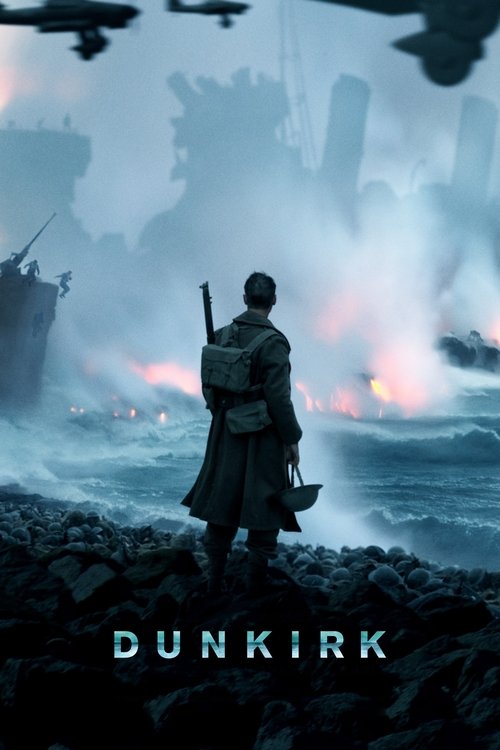
Dunkirk (2017) ends with Farrier's Spitfire gliding silently along the empty beach at dusk on its last drops of fuel, the propeller still, while Tommy reads Churchill's 'We shall fight on the beaches' speech aloud from a newspaper on the homeward train. Christopher Nolan's three braided timelines — one week on the mole, one day at sea, one hour in the air — converge on a survival rather than a victory, and the closing image lets the audience finish the speech for itself.
Plot recap leading into the ending
Dunkirk is a major port city in the department of Nord in northern France. It lies on the North Sea, 10 kilometres (6.2 mi) from the Belgian border. It has the third-largest French harbour. The population of the commune is about 86,000.
Symbolism
Drawing on Hans Zimmer to Matt Grobar (Deadline), Hans Zimmer on CBC Radio q, and Christopher Nolan to Brent Lang (Variety).
The symbolism of Dunkirk (2017) is built from three interlocking devices: the Shepard-tone ticking watch that turns Hans Zimmer's score into a moving clock, the fuel gauge in Farrier's Spitfire that replaces the dramatic countdown of a conventional war film, and the small civilian boats that arrive at the breakwater as the picture's only sustained image of identifiable national identity. Each carries a private mechanical function and a public argument at the same time, and they only resolve as a single system in the final reel.
The Shepard-tone clock
Hans Zimmer's score, in collaboration with Christopher Nolan, is built around an audio illusion that does what no conventional war-movie cue can: it makes time itself feel like a falling object. Speaking to Matt Grobar for Deadline in February 2018, Zimmer described the design as "tension in not making a loud noise. There's tension in the endlessness of a note."1 The Shepard tone — a stack of sine waves an octave apart, the bass continuously rising — produces a sonic loop that appears to keep climbing without ever changing pitch. Nolan supplied Zimmer with a recording of his own pocket watch ticking, and that recording sits underneath every major sequence in the picture. The two devices in combination give the score its central trick: a rising note that never resolves, sitting on top of a clock that never stops. Audiences felt the effect physically. As Zimmer put it to CBC Radio's q programme in October 2017, the score was designed so the music would "absolutely merge with the image" rather than comment on it from outside.2 The clock is not a thematic ornament. It is the engine of the film's three timelines, and it is the reason the mole storyline (a week) and the air storyline (an hour) can run side-by-side on screen without the audience noticing the join: the Shepard tone is, mathematically, the only structure that lets one feel like the other.
The fuel gauge
The film's most-photographed image is not the burning Stuka, the torpedoed destroyer, or the soldiers running for the next boat. It is the pinned-down close-up of Tom Hardy's gloved hand chalking fuel quantities onto the inside of the cockpit canopy as the gauge needle drops past usable readings. Nolan, in conversation with Brent Lang for Variety in November 2017, framed the picture's entire approach in one sentence: "I didn't view this as a war film. I viewed it as a survival story."3 The fuel gauge is the formal expression of that framing. A conventional dogfight scene tracks bullets, altitude, and enemy positions; Nolan's tracks litres. Farrier's combat decisions are forced through a single rising-cost calculation, and the chalked numbers on the glass become the film's only on-screen ledger of what a heroic act actually costs. By the time the needle reads empty over the beach, the symbol has done its work: the audience has been trained to read fuel as life, and to recognise that Farrier's continued presence in the air is the consumption of his own return ticket. The fuel gauge is the war-film countdown clock stripped of its melodrama and reduced to a single inanimate dial.
The small boats
The arrival of the civilian flotilla in the third act is the picture's only sustained image of identifiable British national identity, and the framing is deliberate. Throughout the running time Nolan has refused to show the enemy as a person; the German army appears only as falling leaflets, the howl of a Stuka siren, bullet-holes punching through a hull. When Commander Bolton — played by Kenneth Branagh as a study in stillness — turns toward the breakwater and the line of pleasure craft, fishing trawlers, and lifeboats materialises out of the morning haze, the picture finally gives the audience a face for the side it has been watching for two hours. The shot is held longer than any combat sequence in the film. Branagh delivers the single word "Home" because Nolan's symbol system has already done the rest of the work: the small boats are the only image of "we" that the film has been willing to show, and it has saved them for the moment at which the survival the score has been counting toward arrives in identifiable hands. Read alongside the ticking clock and the fuel gauge, the small boats complete the picture's symbol architecture: a clock that measures time, a dial that measures cost, and a fleet that measures what survival actually looks like when it shows up.
Themes
Drawing on Hans Zimmer on CBC Radio q and Christopher Nolan to Brent Lang (Variety).
The themes of Dunkirk (2017) are three: survival re-framed as victory against the war-film tradition of strategic conquest, the moral asymmetry between the soldier who lives and the soldier who does not, and the collapse of the heroic individual into a system of small contingent acts. Each theme is held in place by a structural decision rather than by dialogue, and the picture only resolves them by colliding all three of its timelines in the same final reel.
Survival as victory
Nolan's most-quoted framing of the project is the sentence Brent Lang printed in Variety in November 2017: "I didn't view this as a war film. I viewed it as a survival story."3 The distinction is not cosmetic. The war-film tradition — from the John Wayne pictures of the 1940s through Saving Private Ryan in 1998 — is organised around the logic of strategic objective: a hill is taken, a bridge is held, a beach is stormed. Dunkirk inverts that logic on its title card. The British Expeditionary Force is not advancing on Berlin; it is retreating across the Channel on whatever floats. The film therefore has to argue, against the genre's grain, that getting 338,000 men off a beach is a story worth telling at the same scale as a story about taking one. Nolan supplies the argument by giving Tommy almost no dialogue, refusing any strategic-overview voice-over, and ending the picture on a soldier reading a newspaper rather than a general signing a treaty. The Variety piece records Nolan's own framing of what suspense requires: "I needed suspense, and the language of suspense is one where you can't take your eyes from the screen."3 Suspense in Dunkirk runs in the opposite direction from a traditional war film. The question is not whether the side will win — the audience knows it will not — but whether each individual on screen will be alive at the end of the reel. The genre's centre of gravity moves from outcome to endurance.
The moral asymmetry of the survivor
The picture stages this theme in two adjacent scenes that the script refuses to comment on. Cillian Murphy's shell-shocked soldier, picked up alone on a sunken destroyer's hull, is the film's most concentrated image of a man who has already survived once and cannot bear to do so again. His panicked eruption below decks ends with George — Barry Keoghan's teenage neighbour — fatally injured. Murphy's character never knows what he has done; Dawson asks his son Peter, "Will he be all right?" and Peter, after a beat, answers "Yes." The exchange is the moral pivot of the entire civilian-boat timeline. Survival in Dunkirk is not distributed by virtue. The shell-shocked soldier lives; the teenager who jumped on the boat to be useful does not. The script makes no effort to balance the books. Brett Lang's Variety profile captured Nolan's resistance to the war-film consolation that survival is somehow earned: the film insists on the genre-uncomfortable proposition that the men who came home from Dunkirk did so by accident, by the courage of strangers, and by the failure of the German army to close the corridor in time. Nolan refuses the language that would let the audience read survival as merit. The film's only verbal recognition of this is the train-platform scene in which a blind veteran touches the soldiers' hands and tells them, "Well done, lads"; one of the soldiers answers, "All we did is survive." The blind man's reply — "That's enough" — is the picture's thesis statement on the morality of getting out alive.
The collapse of the heroic individual
Christopher Nolan's structural choice to braid three timelines at three different scales (one week on the mole, one day at sea, one hour in the air) does more than create suspense. It dismantles the war film's standard delivery vehicle for meaning: the heroic individual whose arc the camera follows from inciting incident to climactic decision. Tommy has no arc; he tries to get on a boat, fails, tries the next one. Mr. Dawson has no inciting incident; his civilian-boat decision is stated in a single sentence and then enacted across a single day. Farrier has no resolution that the script is willing to dramatise as triumph; he glides past empty fuel onto an empty beach and is, in the film's last shot of him, lighting his own aircraft on fire before a German patrol arrives. The picture's heroism is therefore a system rather than a person. Each of the three protagonists makes one small contingent decision — Tommy keeps moving, Dawson keeps going, Farrier stays up — and the survival of 338,000 men is the cumulative product. The Shepard-tone score, designed by Zimmer to "absolutely merge with the image"2, is the audio analogue of this argument: no single instrument carries the melody, but the rising stack of sine waves produces the felt sensation of a single climbing line. Heroism in Dunkirk is the line; the people are the sine waves.
Final shot interpretation
Drawing on Hans Zimmer on CBC Radio q, Christopher Nolan to Brent Lang (Variety), Hoyte van Hoytema to Tom Grater (Screen Daily), and Christopher Nolan to Premiere (via Kate Erbland, IndieWire).
The final shot of Dunkirk (2017) is a controlled superimposition: Farrier's Spitfire glides silently along the empty Dunkirk beach at dusk on its last drops of fuel, the propeller stopped, while Tommy — back on a train rolling across southern England — reads Winston Churchill's "We shall fight on the beaches" speech from the morning newspaper. The two images cut against each other and against Hans Zimmer's score until Farrier lands, climbs out, and lights his own aircraft on fire as a German patrol moves up the dune line. The picture closes on his silhouette against the burning plane and Tommy's eyes on the newsprint, and the speech is finished off-screen by the audience.
The Churchill speech as quotation, not exhortation
Nolan's most pointed authorial decision in the final reel is to deliver Churchill's most famous wartime speech — "We shall fight on the beaches, we shall fight on the landing grounds, we shall fight in the fields and in the streets" — not in the radio register the genre expects but as text on a piece of newspaper read aloud by a single exhausted nineteen-year-old. Fionn Whitehead's Tommy reads the speech without conviction; he reads it the way a soldier who has been on a beach for a week reads a politician's claim that the beach has produced a victory. The framing is the picture's last assertion of its survival-not-heroism argument, the one Nolan summarised for Variety's Brent Lang as the line between "war film" and "survival story."3 The speech is not what the picture believes the moment to mean; the picture believes the moment to mean that 338,000 men got home. The Churchill text is included so that the audience can hear the official rhetoric of victory landing on top of the actual experience of evacuation, and feel the gap between them. The script does not editorialise the gap. The speech is allowed to play, on a train car, in a private voice, and the audience is asked to do the comparison itself.
Farrier's glide
The parallel image — Tom Hardy's Farrier coasting along the sand with his propeller stopped — is the picture's clearest single rebuke to the heroic-pilot trope. The genre expects the dogfight ace to land triumphantly behind British lines, climb out to a cheering crowd, and be debriefed by a senior officer with a clipboard. Nolan gives the audience the opposite: the engine has run dry over the beach, the cheering crowd is on a boat halfway across the Channel, and the only debrief on offer is a German patrol arriving in person. Hoyte van Hoytema's IMAX cinematography — approximately seventy per cent of the film captured on 15-perf 65mm — has been preparing the audience for this shot since the first reel. Van Hoytema described his approach as building "virtual reality without the goggles" in his Screen Daily piece with Tom Grater, carrying the IMAX camera handheld "like a documentary" and shooting practical Spitfires in the air rather than CGI.4 The final glide is the payoff: the camera holds wide on the empty beach, the propeller is genuinely stopped, the aircraft is genuinely on the ground, and the audience is asked to read silence as the actual sound a successful retreat makes. The Shepard tone, after two hours of rising pitch, finally permits itself to resolve. The trick the score has been running — what Zimmer described to CBC Radio's q programme as "the endlessness of a note"2 — closes on a single sustained chord. Farrier's match strikes the fabric of his Spitfire. The plane burns.
The train-platform reception
Cut against the burning Spitfire, the train pulls into a small English station and a blind veteran moves down the carriage handing out beer to the rescued men. He cannot see Tommy. He touches each boy's hand and says, "Well done, lads." One of them — Alex, played by Harry Styles — answers, "All we did is survive." The blind man's reply, "That's enough," is the film's last spoken line and its most direct moral statement. Nolan, in the Variety profile, defended the structure of the final act on suspense rather than sentiment: "I needed suspense, and the language of suspense is one where you can't take your eyes from the screen."3 The train-platform scene is the picture's release of that suspense, and the release is deliberately small. There is no parade. There is no general waiting on the platform. There is a blind man, a beer, and a sentence the script believes is sufficient. The closing montage holds Tommy's eyes on the newsprint while Churchill's speech keeps running, and Farrier — across the Channel, against the silhouette of the burning plane — is taken into German custody.
What the three timelines collide into
The structural payoff of the braided narrative is that the audience finally understands, in the final reel, that the three storylines have been running at three different speeds: the mole timeline a week long, the sea timeline a day, the air timeline a single hour. They converge on the moment Mr. Dawson's boat reaches the breakwater and Farrier's last gallon runs out above it. Nolan's stated goal — recorded in his February 2017 conversation with Premiere magazine and quoted across the trade press5 — was to "mingle these different versions of history" by mixing "the temporal strata." The convergence is the picture's only moment of full clarity. Before it, the audience has been deliberately disorientated; after it, the audience is allowed to see what survival actually cost across three different scales of time. The final shot is the resolution of that experiment. A week, a day, and an hour collapse into one image: a boy reading a newspaper, a pilot lighting a match, and a Shepard tone closing down to silence.
Back to the full movie guide
Plot, cast, where to watch, and similar films — without spoilers.
Open guide →Frequently Asked
What is Dunkirk about?
The story of the miraculous evacuation of Allied soldiers from Belgium, Britain, Canada and France, who were cut off and surrounded by the German army from the beaches and harbour of Dunkirk between May 26th and June 4th 1940 during World War II.
Where can I watch Dunkirk?
See the Where to Watch section below for the current streaming, rental, and purchase options in your region.